
Parte 2 Cartão de dicas
Descreva um evento esportivo ao vivo que você assistiu e gostou
Você deveria dizer:
- O que foi
- Quando e onde você assistiu
- Com quem você assistiu
- E explique por que você gostou
Você terá de um a dois minutos para falar sobre este assunto.
Parte 3 Perguntas para discussão
- Why do some people like to watch sports events?
- Where do people normally watch sports events?
- What are the advantages of watching sports events online?
- What sports matches are suitable for children to attend?
- Why do some people spend a lot going to other countries to watch sports events?
- What sports games are popular in your country?
Status da prática: Tópico arquivado de um ciclo anterior de banco de questões. Ela permanece útil para a prática de habilidades, mas não é apresentada como uma questão de exame atual ou garantida. Como os tópicos são rotulados.
Leia a transcrição completa
A couple of summers ago I watched a World Cup qualifier at the national stadium in my capital city. I went with three close friends; we'd pooled money for tickets and made a whole day of it, meeting for lunch beforehand so it felt like an event rather than just a match. The stadium itself was vast and packed, flags everywhere and non-stop chanting, which created an electric atmosphere that made every minute feel important. The game was dramatic: after a tense first half our team scored a late equaliser and then clinched victory in extra time, which sent the crowd absolutely wild. I enjoyed the match for several reasons — the quality of play was high, with clever runs and precise passing, and there was a real sense of community as strangers high-fived and sang together. Small details made it special too, like the half-time street performers, the friendly banter over a beer and the walk home with everyone still buzzing. I even have a photo of us celebrating by the stadium gate afterwards.
Veja o tópico antes de falar
Use as imagens como sugestões de ideias. Descreva o que você percebe, conecte-o à sua experiência e responda à verdadeira pergunta.
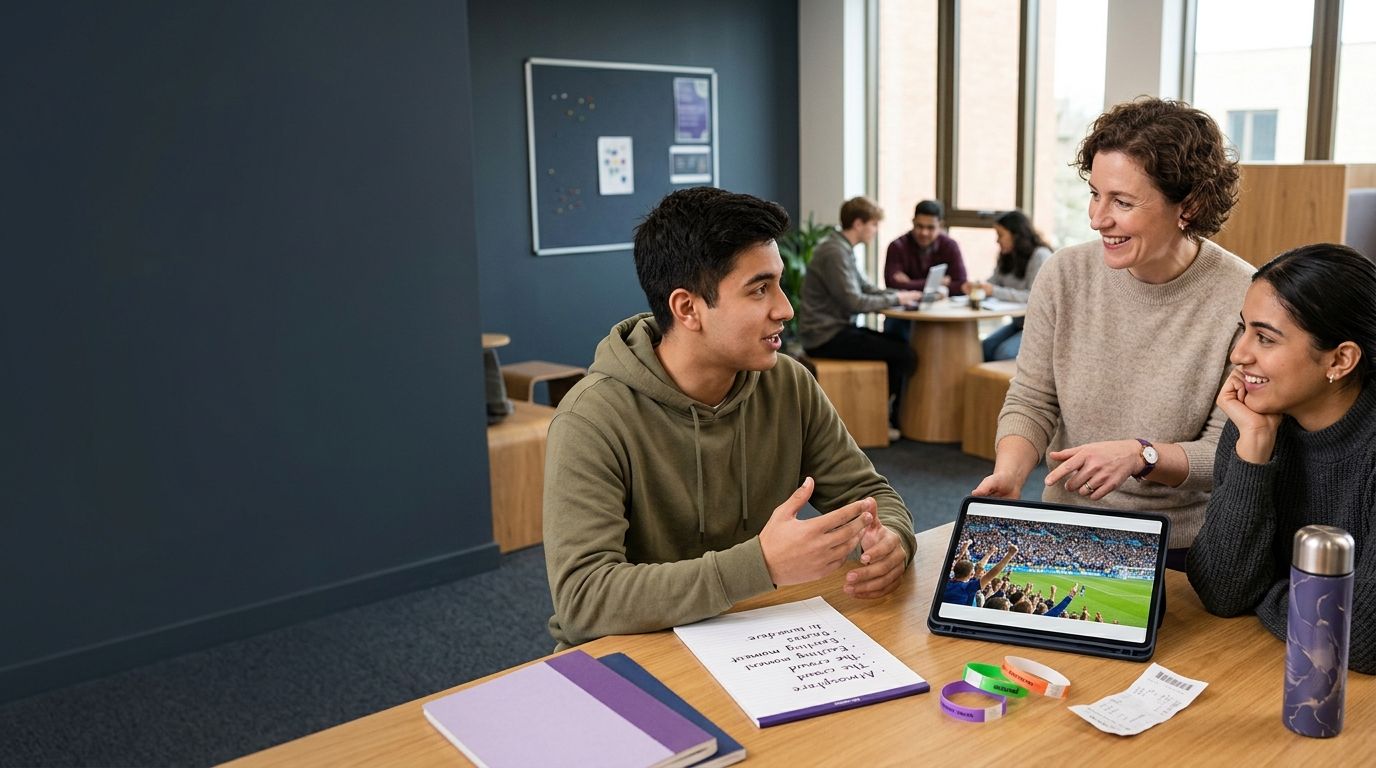

Respostas modelo, ouvidas lado a lado
Comece com a resposta mais simples, mude Band para ouvir como a mesma tarefa pode ser desenvolvida e depois registre uma resposta pessoal. Estes são exemplos didáticos, não respostas oficiais ou garantias de pontuação.
Parte 2 – Resposta do Modelo
Part 2 cue-card response
A couple of years ago I watched a football match at the national stadium. It was an international game between two neighbouring countries. I went with three friends and we had tickets in the upper tier. We met before the match, had a drink and then went into the stadium together. I liked it because the crowd was really noisy and everyone was excited. The team I supported scored a late goal and people around me jumped up and hugged. It felt fun to be with other fans. I also enjoyed seeing good players close up and the whole day stayed in my memory.
A couple of summers ago I watched a World Cup qualifier at the national stadium in my capital city. I went with three close friends; we'd pooled money for tickets and made a whole day of it, meeting for lunch beforehand so it felt like an event rather than just a match. The stadium itself was vast and packed, flags everywhere and non-stop chanting, which created an electric atmosphere that made every minute feel important. The game was dramatic: after a tense first half our team scored a late equaliser and then clinched victory in extra time, which sent the crowd absolutely wild. I enjoyed the match for several reasons — the quality of play was high, with clever runs and precise passing, and there was a real sense of community as strangers high-fived and sang together. Small details made it special too, like the half-time street performers, the friendly banter over a beer and the walk home with everyone still buzzing. I even have a photo of us celebrating by the stadium gate afterwards.
Parte 3 – Respostas do Modelo
Why do some people like to watch sports events?
People watch sports because it's exciting and they like supporting a team. Some enjoy the competition and the drama. Others go for the social side — meeting friends or family. It can also be a habit, people watch every weekend. For some it's a way to relax after work.
Many people are drawn to live sport because it combines drama, uncertainty and a shared emotional experience. Not only is there the thrill of the contest itself, but also the sense of belonging when you support a club or country — that collective identity is powerful. On top of that, sport offers storylines you can follow season after season: underdog victories, rivalries and memorable moments. For some viewers it’s also a ritual, a way to unwind and connect with friends, while for others it’s about admiring skill and tactics.
Where do people normally watch sports events?
People watch sports at the stadium if they want the live feeling. Many watch on TV at home because it's easy and cheaper. Pubs and sports bars are common places to watch with friends. Nowadays people also watch on their phones or laptops online. Big events might be shown in public squares or fan zones.
People watch sports in a variety of places depending on the occasion. For biggest matches many prefer the stadium for atmosphere and the communal buzz, while everyday games are often watched at home on TV for comfort and convenience. Sports bars and pubs are popular because they offer a lively social environment and sometimes better screens. Increasingly, public fan zones or city-centre screenings draw big crowds for major tournaments, and of course mobiles and laptops allow people to watch almost anywhere.
What are the advantages of watching sports events online?
Watching online is handy because you can do it anywhere with your phone or laptop. You can choose replays and different camera angles sometimes. It can be cheaper than buying a ticket. Also you can pause and rewind if you miss something. Internet streams let you watch foreign leagues easily.
Watching sports online offers clear advantages: it's flexible and on-demand, so you can pause, rewind or catch up on highlights whenever you want. Streams often include extra features like multiple camera angles, live statistics and on-screen replays, which can deepen your understanding of the match. There's also interactivity — chat functions and social feeds mean you can join discussions in real time. Finally, online services make foreign competitions easily accessible without the expense or logistics of travel, although reliable internet is essential.
What sports matches are suitable for children to attend?
Young children can go to short and calm matches. School games, local junior football or swimming galas are good. Matches that are not too loud are better. Parents should sit near exits and bring ear defenders if needed. It's important the event is family-friendly.
When choosing matches for children, safety and suitability are key. Junior leagues, school fixtures, athletics meets and daytime tennis are usually appropriate because they tend to be shorter and less intense in terms of crowd behaviour. Family-friendly events with stewarding, clear seating and low levels of hostile chanting are best. Also consider the length and noise level — younger children might struggle with long, late evening fixtures — and make practical preparations, like bringing snacks and ear protection if the crowd gets loud.
Why do some people spend a lot going to other countries to watch sports events?
Some people travel abroad to watch big events like the World Cup or the Olympics. They want to see the match in person and feel the atmosphere. It can be a holiday and chance to visit a new country. Fans also want to support their team and meet other supporters. For many it's a special dream.
For many fans travelling overseas is a kind of pilgrimage: attending a major event like the World Cup, the Olympics or a continental final is a once-in-a-lifetime experience that you can't fully replicate at home. People value the unique atmosphere, the chance to see elite athletes live and the cultural experience of visiting a different country. There's also a social aspect — following a team abroad can cement friendships and create lasting memories. For some it's about status or bucket-list travel, and for others it's simply worth the expense for the emotional payoff.
What sports games are popular in your country?
In my country football is the most popular sport. People also like rugby and cricket. Tennis and athletics get attention during big tournaments. Local sports like badminton or netball are played too. TV shows and local clubs help keep them popular.
In my country football is by far the most popular spectator sport, drawing the largest crowds and media coverage. Rugby and cricket follow, each with strong regional support and a busy fixture calendar. Tennis and athletics also enjoy spikes in interest around major tournaments, while grassroots sports such as netball, cycling and amateur running clubs are widely practised. Popularity varies by age and region: younger people may favour individual or extreme sports, while older generations stick with traditional team games.
Status da prática: Tópico arquivado de um ciclo anterior de banco de questões. Ela permanece útil para a prática de habilidades, mas não é apresentada como uma questão de exame atual ou garantida. Como os tópicos são rotulados.
Como responder Descreva um evento esportivo ao vivo que você assistiu e gostou. Perguntas do IELTS Speaking
Para o cartão de dicas Descreva um evento esportivo ao vivo que você assistiu e gostou, use o minuto de preparação para construir um roteiro através da palestra. Escolha um assunto claro, adicione dois momentos ou detalhes específicos e termine explicando por que é importante. Em seguida, use as perguntas vinculadas da Parte 3 para praticar explicações e comparações mais amplas.
Solicitações do cartão de sugestão:
- O que foi
- Quando e onde você assistiu
- Com quem você assistiu
- E explique por que você gostou
- Abertura: identificar a pessoa, lugar, objeto ou evento.
- Desenvolvimento: descreva dois detalhes ou momentos em uma ordem lógica.
- Extensão: explique um motivo, resultado, comparação ou problema.
- Reflexão: finalize explicando por que o assunto é memorável ou importante.
Abordagem pergunta por pergunta
| Pergunta prática | Movimento de resposta útil |
|---|---|
| Why do some people like to watch sports events? | Responda com uma causa principal e depois apoie-a com um exemplo concreto. |
| Where do people normally watch sports events? | Dê uma resposta direta, um motivo e um pequeno exemplo sem memorizar um roteiro. |
| What are the advantages of watching sports events online? | Nomeie a coisa primeiro e depois descreva um recurso ou exemplo específico. |
| What sports matches are suitable for children to attend? | Nomeie a coisa primeiro e depois descreva um recurso ou exemplo específico. |
Foco no vocabulário
A linguagem útil já demonstrada nas respostas do modelo inclui shared emotional experience, underdog, ritual, communal buzz, fan zone, convenience, on-demand, live statistics. Aprenda cada significado e uma parceria natural de palavras e, em seguida, use o item em uma nova resposta em vez de copiar um script completo.
Erros comuns a evitar
- Dar uma resposta memorizada que responde apenas parcialmente à pergunta.
- Adicionar vocabulário difícil sem verificar o significado ou a colocação.
- Reiniciar após cada erro em vez de corrigir brevemente e continuar.
- Lendo a resposta do modelo antes de gravar sua primeira tentativa.
Descreva um evento esportivo ao vivo que você assistiu e gostou. FAQ de treino
Como devo usar o minuto de preparação do cartão de dicas Descreva um evento esportivo ao vivo que você assistiu e gostou?
Escreva palavras-chave para uma abertura, dois ou três detalhes e uma reflexão final. Não tente escrever frases completas.
Tenho que cobrir todos os marcadores do cartão de sinalização?
As instruções ajudam você a organizar a palestra. Cobri-los é útil, mas uma resposta coerente de um a dois minutos é mais importante do que marcar mecanicamente cada linha.
Como as perguntas da Parte 3 estão conectadas à Parte 2?
Desenvolvem o mesmo tema amplo através de razões, comparações, efeitos sociais ou possibilidades futuras, pelo que as respostas normalmente necessitam de mais explicações do que a Parte 1.
