
IELTS Nói Phần 2 & 3: Describe a boring place

Thẻ gợi ý phần 2
Describe a boring place
Bạn nên nói:
- Nó ở đâu
- Bạn đã đến đó với ai
- Bạn đã làm gì ở đó
- Tại sao bạn nghĩ đó là một nơi nhàm chán
Bạn sẽ có một đến hai phút để nói về chủ đề này.
Đọc bản ghi đầy đủ
One place I found really boring was the local council office in my town. I went there with my mother to renew some paperwork for an elderly relative, and we had to queue for nearly an hour. The office itself is a small, grey room with rows of plastic chairs, a flickering fluorescent light and a TV that only shows public service announcements; it feels like it drains any energy from people. While we were there I filled in forms, listened to other people's dull conversations about appointments, and tried to read a leaflet about recycling that was full of dense, bureaucratic language; there wasn't much else to do. It felt boring because everything was slow and repetitive, and there was no attempt to make the place welcoming or interesting — no displays, no music, nothing to engage you. Also the tasks you're doing are tedious and mechanical, so time slows down. For example, at one point a woman beside me started a crossword and then fell asleep. There was a faint smell of cleaning fluid and the heating made the air stale, which didn't help. The staff spoke in monotone and seemed rushed, so there was no friendly chat to pass the time. Altogether it was one of those experiences that makes you check your watch every few minutes.
Trạng thái chuẩn bị: Dự đoán chu kỳ chủ đề. Tài nguyên thực hành độc lập này không phải là bài thi IELTS chính thức và các câu hỏi trong bài kiểm tra của bạn có thể khác nhau. Cách gắn nhãn chủ đề.
Câu hỏi thảo luận phần 3
Di chuyển từng câu hỏi một: nghe, trả lời, so sánh và thử lại. Văn bản câu hỏi hoàn chỉnh vẫn còn trong trang HTML để truy cập và tìm kiếm.
- 01Why do most children think education is boring?
- 02Why aren't young people willing to listen to the experiences of older people?
- 03What can people do when they feel bored?
- 04Why are some teachers' classes boring? Are there any solutions?
- 05Why do some young people feel bored when talking with old people?
- 06Do most people think news about celebrities is boring?
Xem chủ đề trước khi nói
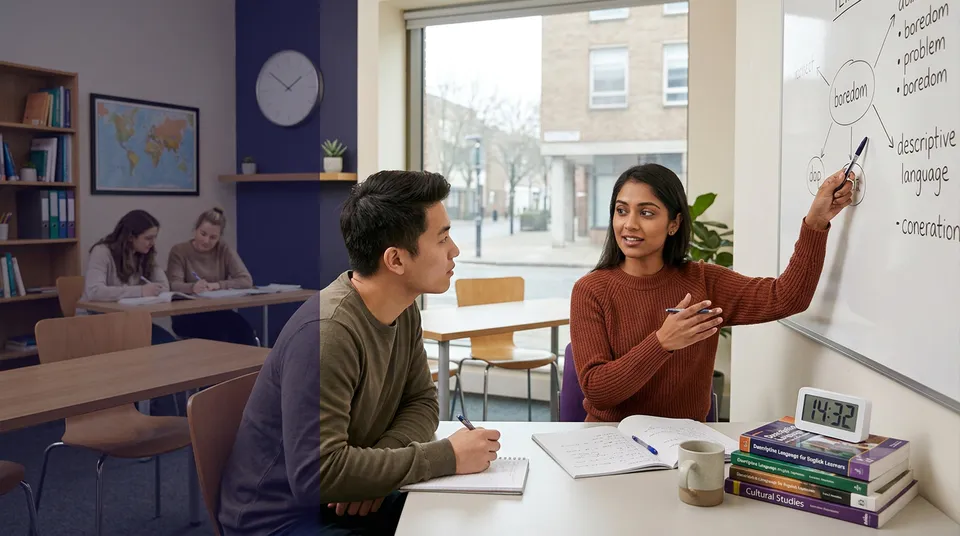
Sử dụng hình ảnh làm gợi ý tưởng. Mô tả những gì bạn nhận thấy, kết nối nó với trải nghiệm của bạn, sau đó trả lời câu hỏi thực sự.

Những câu trả lời mẫu, được nghe cạnh nhau
Bắt đầu với câu trả lời đơn giản hơn, chuyển Band để nghe cách phát triển nhiệm vụ tương tự, sau đó ghi lại câu trả lời cá nhân. Đây là những ví dụ giảng dạy, không phải câu trả lời chính thức hoặc đảm bảo điểm số.
Phần 2 – Câu trả lời mẫu
Part 2 cue-card response
I want to describe a place I found boring: the local council office. I went there with my mum to sort out some paperwork for an elderly relative. We sat in the waiting room and waited a long time. I filled in forms, looked at some outdated posters on the wall and chatted a little with my mum. It was boring because nothing happened, the chairs were hard and the staff moved slowly. There was nothing to do, no magazines or music. Time passed very slowly and I kept checking the door and my phone.
One place I found really boring was the local council office in my town. I went there with my mother to renew some paperwork for an elderly relative, and we had to queue for nearly an hour. The office itself is a small, grey room with rows of plastic chairs, a flickering fluorescent light and a TV that only shows public service announcements; it feels like it drains any energy from people. While we were there I filled in forms, listened to other people's dull conversations about appointments, and tried to read a leaflet about recycling that was full of dense, bureaucratic language; there wasn't much else to do. It felt boring because everything was slow and repetitive, and there was no attempt to make the place welcoming or interesting — no displays, no music, nothing to engage you. Also the tasks you're doing are tedious and mechanical, so time slows down. For example, at one point a woman beside me started a crossword and then fell asleep. There was a faint smell of cleaning fluid and the heating made the air stale, which didn't help. The staff spoke in monotone and seemed rushed, so there was no friendly chat to pass the time. Altogether it was one of those experiences that makes you check your watch every few minutes.
Phần 3 - Câu trả lời mẫu
Why do most children think education is boring?
Children often think education is boring because lessons can be the same every day. Teachers might talk for a long time and pupils just listen. Many kids would prefer more games or practical work. Also tests make school feel like chores.
Many children find school dull because the system still relies heavily on rote learning and frequent testing, which reduces learning to memorising facts. When lessons are teacher-centred and there’s little hands-on activity, pupils quickly disengage. Short attention spans, fuelled by fast-paced digital media, make slow-paced lectures seem especially tedious. By contrast, project-based tasks or practical experiments can make topics feel relevant and spark curiosity — for instance, a science lesson with a simple experiment often holds attention far better than a long explanation.
Why aren't young people willing to listen to the experiences of older people?
Young people sometimes don't want to listen to older people because they think older people are out of touch. They prefer talking to friends their own age. Also older people can tell long stories that seem boring to youth.
There are a few reasons why younger people may not listen to the older generation: a perceived gap in values, different cultural references and the speed of change in technology. Older people may tell long, detailed stories that don't connect with modern concerns, so younger listeners switch off. Sometimes it's also about attitude — young people want to feel respected and may ignore advice if it sounds like lecturing. However, when older people adapt their language and focus on shared experiences, conversations become much more rewarding for both sides.
What can people do when they feel bored?
If someone feels bored they can read a book, go for a walk, call a friend or watch a film. Doing a hobby helps. Even a short exercise session can change your mood.
When boredom strikes, a good approach is to change your environment or start a small, focused task. Learning a new skill in short bursts, going for a brisk walk, or trying a ten-minute writing sprint can quickly refresh your mind. Volunteering or joining a local class also gives purpose and social contact, which beats passive scrolling. Mindfulness techniques can help you tolerate quiet moments and sometimes boredom is a cue to try something new rather than a problem to be immediately fixed.
Why are some teachers' classes boring? Are there any solutions?
Some teachers are boring because they just read from the board and speak in a flat voice. They don't use activities or ask students to join in. One way to fix this is to make classes more interactive, with group work or games.
Classes become boring when teaching is monotonous, teacher-centred and lacks variety; this often happens because of large classes, heavy curricula or limited teacher training. There are practical solutions: use active-learning techniques, flip parts of the lesson so students prepare at home and do practical tasks in class, and vary the pace with short activities. Regular formative checks and using storytelling or real-world examples can also make material more memorable. These changes require planning, but they make lessons far more engaging in the long run.
Why do some young people feel bored when talking with old people?
Young people can get bored talking to older people because their interests are different. Old people repeat stories and speak more slowly. Young people like faster, more lively chats.
Boredom in intergenerational conversations often comes from a mismatch of topics and tempo: older speakers may focus on past events or detailed memories, while younger people prefer quick, topical exchanges. Technology also plays a part, since younger people are used to rapid, multimedia communication. That said, boredom can be reduced if both ask open questions and look for common ground — for example, discussing music, food or local events can bridge the gap and create a lively exchange.
Do most people think news about celebrities is boring?
Some people think celebrity news is boring because it's not important and it's the same stories again and again. But other people enjoy it as light entertainment. It depends on the person.
Many find celebrity news trivial because it tends to be repetitive, sensational and lacking in depth, so it doesn't provide real information about society. However, celebrity coverage also serves as light entertainment and social currency — people often enjoy gossip or follow stars for fashion and lifestyle ideas. Algorithms on social media amplify this content, making it seem more important than it is. Personally, I think it's fine in small doses, but too much can crowd out more important news.
Cách trả lời câu hỏi Miêu tả một nơi nhàm chán trong IELTS Nói
Đối với thẻ gợi ý Mô tả một địa điểm nhàm chán, hãy sử dụng phút chuẩn bị để xây dựng lộ trình xuyên suốt bài nói chuyện. Chọn một chủ đề rõ ràng, thêm hai khoảnh khắc hoặc chi tiết cụ thể và kết thúc bằng lý do tại sao nó quan trọng. Sau đó sử dụng các câu hỏi Phần 3 được liên kết để thực hành giải thích và so sánh rộng hơn.
Lời nhắc của thẻ Cue:
- Nó ở đâu
- Bạn đã đến đó với ai
- Bạn đã làm gì ở đó
- Tại sao bạn nghĩ đó là một nơi nhàm chán
- Mở đầu: xác định người, địa điểm, đồ vật hoặc sự kiện.
- Phát triển: mô tả hai chi tiết hoặc khoảnh khắc theo một trình tự hợp lý.
- Phần mở rộng: giải thích lý do, kết quả, so sánh hoặc vấn đề.
- Suy ngẫm: kết thúc bằng việc tại sao chủ đề lại đáng nhớ hoặc quan trọng.
Cách tiếp cận theo từng câu hỏi
| Câu hỏi thực hành | Câu trả lời hữu ích di chuyển |
|---|---|
| Why do most children think education is boring? | Trả lời bằng một nguyên nhân chính, sau đó hỗ trợ nó bằng một ví dụ cụ thể. |
| Why aren't young people willing to listen to the experiences of older people? | Trả lời bằng một nguyên nhân chính, sau đó hỗ trợ nó bằng một ví dụ cụ thể. |
| What can people do when they feel bored? | Đặt tên cho sự vật trước, sau đó mô tả một tính năng hoặc ví dụ cụ thể. |
| Why are some teachers' classes boring? Are there any solutions? | Trả lời bằng một nguyên nhân chính, sau đó hỗ trợ nó bằng một ví dụ cụ thể. |
Trọng tâm từ vựng
Ngôn ngữ hữu ích đã được trình bày trong các câu trả lời mẫu bao gồm rote learning, project-based, engage (engagement), out of touch, cultural references, switch off, brisk walk, ten-minute sprint. Tìm hiểu từng nghĩa và cách kết hợp từ tự nhiên, sau đó sử dụng mục đó trong câu trả lời mới thay vì sao chép toàn bộ văn bản.
Những lỗi thường gặp cần tránh
- Đưa ra một câu trả lời thuộc lòng mà chỉ trả lời được một phần câu hỏi.
- Bổ sung từ vựng khó mà không cần kiểm tra nghĩa hoặc sắp xếp thứ tự.
- Khởi động lại sau mỗi lỗi thay vì sửa nhanh và tiếp tục.
- Đọc câu trả lời mẫu trước khi ghi lại lần thử đầu tiên của bạn.
Mô tả một câu hỏi thường gặp về luyện tập ở một nơi nhàm chán
Tôi nên sử dụng phút chuẩn bị thẻ gợi ý Mô tả một địa điểm nhàm chán như thế nào?
Viết từ khóa cho phần mở đầu, hai hoặc ba chi tiết và suy ngẫm cuối cùng. Đừng cố gắng viết câu hoàn chỉnh.
Tôi có phải che từng viên đạn của thẻ gợi ý không?
Những lời nhắc giúp bạn tổ chức cuộc nói chuyện. Bao gồm chúng là hữu ích, nhưng một phản hồi mạch lạc từ một đến hai phút quan trọng hơn việc đánh dấu từng dòng một cách máy móc.
Các câu hỏi của Phần 3 được kết nối với Phần 2 như thế nào?
Chúng phát triển cùng một chủ đề rộng thông qua các lý do, so sánh, hiệu ứng xã hội hoặc khả năng trong tương lai, vì vậy các câu trả lời thường cần được giải thích nhiều hơn Phần 1.
