
IELTS การพูด ตอนที่ 2 และ 3: Describe a boring place

ส่วนที่ 2 บัตรคิว
Describe a boring place
คุณควรพูดว่า:
- มันอยู่ที่ไหน
- คุณไปที่นั่นกับใคร
- สิ่งที่คุณทำที่นั่น
- ทำไมคุณถึงคิดว่ามันเป็นสถานที่ที่น่าเบื่อ
คุณจะมีเวลาหนึ่งถึงสองนาทีในการพูดคุยเกี่ยวกับหัวข้อนี้
อ่านบทบรรยายฉบับสมบูรณ์
One place I found really boring was the local council office in my town. I went there with my mother to renew some paperwork for an elderly relative, and we had to queue for nearly an hour. The office itself is a small, grey room with rows of plastic chairs, a flickering fluorescent light and a TV that only shows public service announcements; it feels like it drains any energy from people. While we were there I filled in forms, listened to other people's dull conversations about appointments, and tried to read a leaflet about recycling that was full of dense, bureaucratic language; there wasn't much else to do. It felt boring because everything was slow and repetitive, and there was no attempt to make the place welcoming or interesting — no displays, no music, nothing to engage you. Also the tasks you're doing are tedious and mechanical, so time slows down. For example, at one point a woman beside me started a crossword and then fell asleep. There was a faint smell of cleaning fluid and the heating made the air stale, which didn't help. The staff spoke in monotone and seemed rushed, so there was no friendly chat to pass the time. Altogether it was one of those experiences that makes you check your watch every few minutes.
สถานะการเตรียมการ: รอบหัวข้อที่คาดการณ์ไว้ แหล่งข้อมูลสำหรับฝึกหัดอิสระนี้ไม่ใช่ข้อสอบ IELTS อย่างเป็นทางการ และคำถามในการทดสอบอาจแตกต่างกันออกไป วิธีการติดป้ายกำกับหัวข้อ.
ส่วนที่ 3 คำถามสนทนา
ย้ายทีละคำถาม: ฟัง ตอบ เปรียบเทียบ และลองอีกครั้ง ข้อความคำถามที่สมบูรณ์จะยังคงอยู่ในหน้า HTML เพื่อการเข้าถึงและการค้นหา
- 01Why do most children think education is boring?
- 02Why aren't young people willing to listen to the experiences of older people?
- 03What can people do when they feel bored?
- 04Why are some teachers' classes boring? Are there any solutions?
- 05Why do some young people feel bored when talking with old people?
- 06Do most people think news about celebrities is boring?
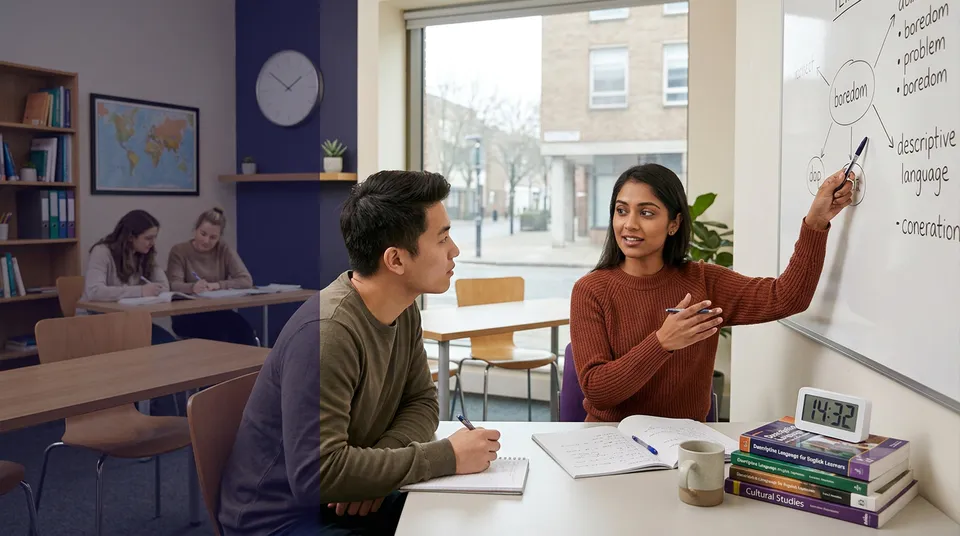
ดูหัวข้อก่อนพูด
ใช้รูปภาพเป็นไอเดีย อธิบายสิ่งที่คุณสังเกตเห็น เชื่อมโยงกับประสบการณ์ของคุณ แล้วตอบคำถามจริง

โมเดลตอบ ได้ยินพร้อมๆ กัน
เริ่มต้นด้วยคำตอบที่ง่ายกว่า สลับ Band เพื่อฟังว่างานเดียวกันนี้สามารถพัฒนาได้อย่างไร จากนั้นจึงบันทึกคำตอบส่วนตัว นี่เป็นตัวอย่างการสอน ไม่ใช่คำตอบอย่างเป็นทางการหรือการรับประกันคะแนน
ส่วนที่ 2 - คำตอบของแบบจำลอง
Part 2 cue-card response
I want to describe a place I found boring: the local council office. I went there with my mum to sort out some paperwork for an elderly relative. We sat in the waiting room and waited a long time. I filled in forms, looked at some outdated posters on the wall and chatted a little with my mum. It was boring because nothing happened, the chairs were hard and the staff moved slowly. There was nothing to do, no magazines or music. Time passed very slowly and I kept checking the door and my phone.
One place I found really boring was the local council office in my town. I went there with my mother to renew some paperwork for an elderly relative, and we had to queue for nearly an hour. The office itself is a small, grey room with rows of plastic chairs, a flickering fluorescent light and a TV that only shows public service announcements; it feels like it drains any energy from people. While we were there I filled in forms, listened to other people's dull conversations about appointments, and tried to read a leaflet about recycling that was full of dense, bureaucratic language; there wasn't much else to do. It felt boring because everything was slow and repetitive, and there was no attempt to make the place welcoming or interesting — no displays, no music, nothing to engage you. Also the tasks you're doing are tedious and mechanical, so time slows down. For example, at one point a woman beside me started a crossword and then fell asleep. There was a faint smell of cleaning fluid and the heating made the air stale, which didn't help. The staff spoke in monotone and seemed rushed, so there was no friendly chat to pass the time. Altogether it was one of those experiences that makes you check your watch every few minutes.
ส่วนที่ 3 - คำตอบของแบบจำลอง
Why do most children think education is boring?
Children often think education is boring because lessons can be the same every day. Teachers might talk for a long time and pupils just listen. Many kids would prefer more games or practical work. Also tests make school feel like chores.
Many children find school dull because the system still relies heavily on rote learning and frequent testing, which reduces learning to memorising facts. When lessons are teacher-centred and there’s little hands-on activity, pupils quickly disengage. Short attention spans, fuelled by fast-paced digital media, make slow-paced lectures seem especially tedious. By contrast, project-based tasks or practical experiments can make topics feel relevant and spark curiosity — for instance, a science lesson with a simple experiment often holds attention far better than a long explanation.
Why aren't young people willing to listen to the experiences of older people?
Young people sometimes don't want to listen to older people because they think older people are out of touch. They prefer talking to friends their own age. Also older people can tell long stories that seem boring to youth.
There are a few reasons why younger people may not listen to the older generation: a perceived gap in values, different cultural references and the speed of change in technology. Older people may tell long, detailed stories that don't connect with modern concerns, so younger listeners switch off. Sometimes it's also about attitude — young people want to feel respected and may ignore advice if it sounds like lecturing. However, when older people adapt their language and focus on shared experiences, conversations become much more rewarding for both sides.
What can people do when they feel bored?
If someone feels bored they can read a book, go for a walk, call a friend or watch a film. Doing a hobby helps. Even a short exercise session can change your mood.
When boredom strikes, a good approach is to change your environment or start a small, focused task. Learning a new skill in short bursts, going for a brisk walk, or trying a ten-minute writing sprint can quickly refresh your mind. Volunteering or joining a local class also gives purpose and social contact, which beats passive scrolling. Mindfulness techniques can help you tolerate quiet moments and sometimes boredom is a cue to try something new rather than a problem to be immediately fixed.
Why are some teachers' classes boring? Are there any solutions?
Some teachers are boring because they just read from the board and speak in a flat voice. They don't use activities or ask students to join in. One way to fix this is to make classes more interactive, with group work or games.
Classes become boring when teaching is monotonous, teacher-centred and lacks variety; this often happens because of large classes, heavy curricula or limited teacher training. There are practical solutions: use active-learning techniques, flip parts of the lesson so students prepare at home and do practical tasks in class, and vary the pace with short activities. Regular formative checks and using storytelling or real-world examples can also make material more memorable. These changes require planning, but they make lessons far more engaging in the long run.
Why do some young people feel bored when talking with old people?
Young people can get bored talking to older people because their interests are different. Old people repeat stories and speak more slowly. Young people like faster, more lively chats.
Boredom in intergenerational conversations often comes from a mismatch of topics and tempo: older speakers may focus on past events or detailed memories, while younger people prefer quick, topical exchanges. Technology also plays a part, since younger people are used to rapid, multimedia communication. That said, boredom can be reduced if both ask open questions and look for common ground — for example, discussing music, food or local events can bridge the gap and create a lively exchange.
Do most people think news about celebrities is boring?
Some people think celebrity news is boring because it's not important and it's the same stories again and again. But other people enjoy it as light entertainment. It depends on the person.
Many find celebrity news trivial because it tends to be repetitive, sensational and lacking in depth, so it doesn't provide real information about society. However, celebrity coverage also serves as light entertainment and social currency — people often enjoy gossip or follow stars for fashion and lifestyle ideas. Algorithms on social media amplify this content, making it seem more important than it is. Personally, I think it's fine in small doses, but too much can crowd out more important news.
วิธีตอบ อธิบายสถานที่ที่น่าเบื่อ คำถาม IELTS Speaking
สำหรับบัตรคิวอธิบายสถานที่ที่น่าเบื่อ ให้ใช้นาทีการเตรียมการเพื่อสร้างเส้นทางผ่านการพูดคุย เลือกหัวข้อที่ชัดเจน เพิ่มช่วงเวลาหรือรายละเอียดที่เฉพาะเจาะจงสองรายการ และจบด้วยเหตุผลว่าทำไมจึงสำคัญ จากนั้นใช้คำถามส่วนที่ 3 ที่เชื่อมโยงเพื่อฝึกฝนการอธิบายและการเปรียบเทียบที่กว้างขึ้น
ข้อความแจ้งบัตรคิว:
- มันอยู่ที่ไหน
- คุณไปที่นั่นกับใคร
- สิ่งที่คุณทำที่นั่น
- ทำไมคุณถึงคิดว่ามันเป็นสถานที่ที่น่าเบื่อ
- การเปิด: ระบุบุคคล สถานที่ วัตถุ หรือเหตุการณ์
- การพัฒนา: อธิบายสองรายละเอียดหรือช่วงเวลาตามลำดับตรรกะ
- ส่วนขยาย: อธิบายเหตุผล ผลลัพธ์ การเปรียบเทียบ หรือปัญหา
- การสะท้อนกลับ: จบด้วยเหตุผลว่าทำไมหัวข้อนั้นถึงน่าจดจำหรือสำคัญ
แนวทางคำถามต่อคำถาม
| คำถามฝึกหัด | การย้ายคำตอบที่เป็นประโยชน์ |
|---|---|
| Why do most children think education is boring? | ตอบด้วยสาเหตุหลักเพียงข้อเดียว แล้วสนับสนุนด้วยตัวอย่างที่เป็นรูปธรรม |
| Why aren't young people willing to listen to the experiences of older people? | ตอบด้วยสาเหตุหลักเพียงข้อเดียว แล้วสนับสนุนด้วยตัวอย่างที่เป็นรูปธรรม |
| What can people do when they feel bored? | ตั้งชื่อสิ่งนั้นก่อน จากนั้นจึงอธิบายคุณลักษณะหรือตัวอย่างเฉพาะเจาะจง |
| Why are some teachers' classes boring? Are there any solutions? | ตอบด้วยสาเหตุหลักเพียงข้อเดียว แล้วสนับสนุนด้วยตัวอย่างที่เป็นรูปธรรม |
เน้นคำศัพท์
ภาษาที่มีประโยชน์แสดงให้เห็นแล้วในคำตอบของโมเดล ได้แก่ rote learning, project-based, engage (engagement), out of touch, cultural references, switch off, brisk walk, ten-minute sprint. เรียนรู้แต่ละความหมายและคู่คำที่เป็นธรรมชาติ จากนั้นใช้รายการนั้นเป็นคำตอบใหม่แทนที่จะคัดลอกสคริปต์ที่สมบูรณ์
ข้อผิดพลาดทั่วไปที่ควรหลีกเลี่ยง
- ให้คำตอบที่จดจำซึ่งตอบคำถามเพียงบางส่วนเท่านั้น
- เติมคำศัพท์ยากๆ โดยไม่ต้องตรวจสอบความหมายหรือการจัดตำแหน่ง
- รีสตาร์ทหลังจากทุกข้อผิดพลาด แทนที่จะแก้ไขในช่วงสั้นๆ และดำเนินการต่อ
- อ่านคำตอบของแบบจำลองก่อนที่จะบันทึกความพยายามครั้งแรกของคุณเอง
อธิบายคำถามที่พบบ่อยเกี่ยวกับสถานที่ปฏิบัติที่น่าเบื่อ
ฉันควรใช้นาทีการเตรียมบัตรคิวอธิบายสถานที่ที่น่าเบื่ออย่างไร
เขียนคำหลักสำหรับช่วงเริ่มต้น รายละเอียดสองหรือสามรายละเอียด และการไตร่ตรองขั้นสุดท้าย อย่าพยายามเขียนประโยคที่สมบูรณ์
ฉันต้องครอบคลุมสัญลักษณ์แสดงหัวข้อย่อยทุกบัตรคิวหรือไม่
ข้อความแจ้งจะช่วยคุณจัดระเบียบการสนทนา การครอบคลุมสิ่งเหล่านี้มีประโยชน์ แต่การตอบสนองหนึ่งถึงสองนาทีที่สอดคล้องกันนั้นมีความสำคัญมากกว่าการทำเครื่องหมายแต่ละบรรทัดโดยอัตโนมัติ
คำถามส่วนที่ 3 เชื่อมโยงกับส่วนที่ 2 อย่างไร
พวกเขาพัฒนาหัวข้อกว้างๆ ที่เหมือนกันด้วยเหตุผล การเปรียบเทียบ ผลกระทบทางสังคม หรือความเป็นไปได้ในอนาคต ดังนั้น คำตอบโดยปกติจะต้องมีคำอธิบายมากกว่าส่วนที่ 1
