
IELTS Speaking, parties 2 et 3 : Describe a boring place

Carte aide-mémoire de la deuxième partie
Describe a boring place
Il faudrait dire :
- Où c'est
- Avec qui es-tu allé là-bas
- Ce que tu as fait là
- Pourquoi tu penses que c'est un endroit ennuyeux
Vous disposerez d'une à deux minutes pour aborder ce sujet.
Lire la transcription complète
One place I found really boring was the local council office in my town. I went there with my mother to renew some paperwork for an elderly relative, and we had to queue for nearly an hour. The office itself is a small, grey room with rows of plastic chairs, a flickering fluorescent light and a TV that only shows public service announcements; it feels like it drains any energy from people. While we were there I filled in forms, listened to other people's dull conversations about appointments, and tried to read a leaflet about recycling that was full of dense, bureaucratic language; there wasn't much else to do. It felt boring because everything was slow and repetitive, and there was no attempt to make the place welcoming or interesting — no displays, no music, nothing to engage you. Also the tasks you're doing are tedious and mechanical, so time slows down. For example, at one point a woman beside me started a crossword and then fell asleep. There was a faint smell of cleaning fluid and the heating made the air stale, which didn't help. The staff spoke in monotone and seemed rushed, so there was no friendly chat to pass the time. Altogether it was one of those experiences that makes you check your watch every few minutes.
État de préparation : cycle thématique prévu. Cette ressource de pratique indépendante n'est pas un document officiel de l'IELTS et les questions de votre test peuvent être différentes. Comment les sujets sont étiquetés.
Questions de discussion de la troisième partie
Déplacez une question à la fois : écoutez, répondez, comparez et réessayez. Le texte complet de la question reste dans la page HTML pour l'accessibilité et la recherche.
- 01Why do most children think education is boring?
- 02Why aren't young people willing to listen to the experiences of older people?
- 03What can people do when they feel bored?
- 04Why are some teachers' classes boring? Are there any solutions?
- 05Why do some young people feel bored when talking with old people?
- 06Do most people think news about celebrities is boring?
Voir le sujet avant de parler
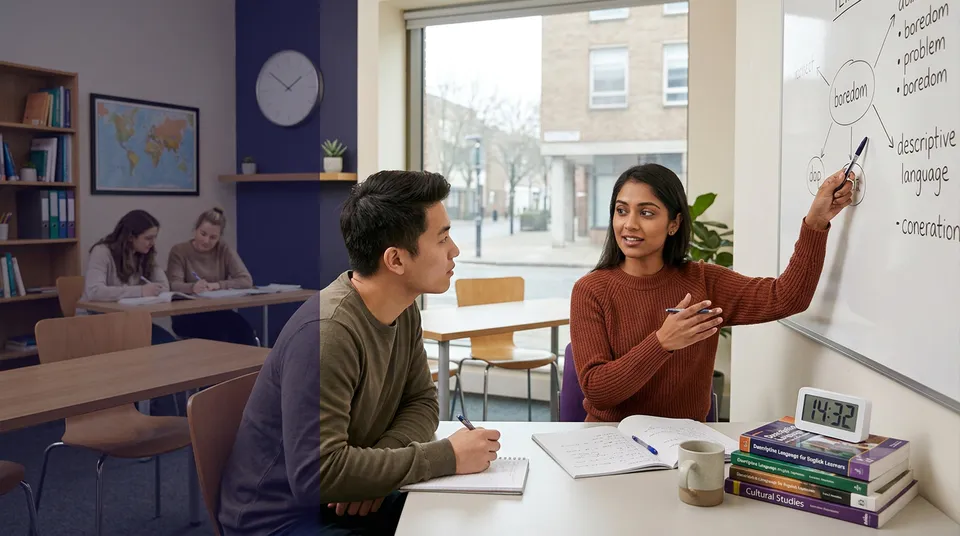
Utilisez les images comme invites à idées. Décrivez ce que vous remarquez, reliez-le à votre expérience, puis répondez à la vraie question.

Des réponses modèles, entendues côte à côte
Commencez par la réponse la plus simple, changez Band pour entendre comment la même tâche peut être développée, puis enregistrez une réponse personnelle. Ce sont des exemples pédagogiques, pas des réponses officielles ni des garanties de scores.
Partie 2 — Modèle de réponse
Part 2 cue-card response
I want to describe a place I found boring: the local council office. I went there with my mum to sort out some paperwork for an elderly relative. We sat in the waiting room and waited a long time. I filled in forms, looked at some outdated posters on the wall and chatted a little with my mum. It was boring because nothing happened, the chairs were hard and the staff moved slowly. There was nothing to do, no magazines or music. Time passed very slowly and I kept checking the door and my phone.
One place I found really boring was the local council office in my town. I went there with my mother to renew some paperwork for an elderly relative, and we had to queue for nearly an hour. The office itself is a small, grey room with rows of plastic chairs, a flickering fluorescent light and a TV that only shows public service announcements; it feels like it drains any energy from people. While we were there I filled in forms, listened to other people's dull conversations about appointments, and tried to read a leaflet about recycling that was full of dense, bureaucratic language; there wasn't much else to do. It felt boring because everything was slow and repetitive, and there was no attempt to make the place welcoming or interesting — no displays, no music, nothing to engage you. Also the tasks you're doing are tedious and mechanical, so time slows down. For example, at one point a woman beside me started a crossword and then fell asleep. There was a faint smell of cleaning fluid and the heating made the air stale, which didn't help. The staff spoke in monotone and seemed rushed, so there was no friendly chat to pass the time. Altogether it was one of those experiences that makes you check your watch every few minutes.
Partie 3 — Modèle de réponses
Why do most children think education is boring?
Children often think education is boring because lessons can be the same every day. Teachers might talk for a long time and pupils just listen. Many kids would prefer more games or practical work. Also tests make school feel like chores.
Many children find school dull because the system still relies heavily on rote learning and frequent testing, which reduces learning to memorising facts. When lessons are teacher-centred and there’s little hands-on activity, pupils quickly disengage. Short attention spans, fuelled by fast-paced digital media, make slow-paced lectures seem especially tedious. By contrast, project-based tasks or practical experiments can make topics feel relevant and spark curiosity — for instance, a science lesson with a simple experiment often holds attention far better than a long explanation.
Why aren't young people willing to listen to the experiences of older people?
Young people sometimes don't want to listen to older people because they think older people are out of touch. They prefer talking to friends their own age. Also older people can tell long stories that seem boring to youth.
There are a few reasons why younger people may not listen to the older generation: a perceived gap in values, different cultural references and the speed of change in technology. Older people may tell long, detailed stories that don't connect with modern concerns, so younger listeners switch off. Sometimes it's also about attitude — young people want to feel respected and may ignore advice if it sounds like lecturing. However, when older people adapt their language and focus on shared experiences, conversations become much more rewarding for both sides.
What can people do when they feel bored?
If someone feels bored they can read a book, go for a walk, call a friend or watch a film. Doing a hobby helps. Even a short exercise session can change your mood.
When boredom strikes, a good approach is to change your environment or start a small, focused task. Learning a new skill in short bursts, going for a brisk walk, or trying a ten-minute writing sprint can quickly refresh your mind. Volunteering or joining a local class also gives purpose and social contact, which beats passive scrolling. Mindfulness techniques can help you tolerate quiet moments and sometimes boredom is a cue to try something new rather than a problem to be immediately fixed.
Why are some teachers' classes boring? Are there any solutions?
Some teachers are boring because they just read from the board and speak in a flat voice. They don't use activities or ask students to join in. One way to fix this is to make classes more interactive, with group work or games.
Classes become boring when teaching is monotonous, teacher-centred and lacks variety; this often happens because of large classes, heavy curricula or limited teacher training. There are practical solutions: use active-learning techniques, flip parts of the lesson so students prepare at home and do practical tasks in class, and vary the pace with short activities. Regular formative checks and using storytelling or real-world examples can also make material more memorable. These changes require planning, but they make lessons far more engaging in the long run.
Why do some young people feel bored when talking with old people?
Young people can get bored talking to older people because their interests are different. Old people repeat stories and speak more slowly. Young people like faster, more lively chats.
Boredom in intergenerational conversations often comes from a mismatch of topics and tempo: older speakers may focus on past events or detailed memories, while younger people prefer quick, topical exchanges. Technology also plays a part, since younger people are used to rapid, multimedia communication. That said, boredom can be reduced if both ask open questions and look for common ground — for example, discussing music, food or local events can bridge the gap and create a lively exchange.
Do most people think news about celebrities is boring?
Some people think celebrity news is boring because it's not important and it's the same stories again and again. But other people enjoy it as light entertainment. It depends on the person.
Many find celebrity news trivial because it tends to be repetitive, sensational and lacking in depth, so it doesn't provide real information about society. However, celebrity coverage also serves as light entertainment and social currency — people often enjoy gossip or follow stars for fashion and lifestyle ideas. Algorithms on social media amplify this content, making it seem more important than it is. Personally, I think it's fine in small doses, but too much can crowd out more important news.
Comment répondre Décrire un endroit ennuyeux Questions orales IELTS
Pour la carte aide-mémoire Décrire un lieu ennuyeux, utilisez la minute de préparation pour construire un itinéraire à travers l’exposé. Choisissez un sujet clair, ajoutez deux moments ou détails spécifiques et terminez par pourquoi c'est important. Utilisez ensuite les questions liées de la partie 3 pour pratiquer des explications et des comparaisons plus larges.
Invites de la carte aide-mémoire :
- Où c'est
- Avec qui es-tu allé là-bas
- Ce que tu as fait là
- Pourquoi tu penses que c'est un endroit ennuyeux
- Ouverture : identifier la personne, le lieu, l'objet ou l'événement.
- Développement : décrire deux détails ou moments dans un ordre logique.
- Extension : expliquer une raison, un résultat, une comparaison ou un problème.
- Réflexion : terminez par pourquoi le sujet est mémorable ou important.
Approche question par question
| Question pratique | Mouvement de réponse utile |
|---|---|
| Why do most children think education is boring? | Répondez par une cause principale, puis soutenez-la par un exemple concret. |
| Why aren't young people willing to listen to the experiences of older people? | Répondez par une cause principale, puis soutenez-la par un exemple concret. |
| What can people do when they feel bored? | Nommez d’abord la chose, puis décrivez une fonctionnalité ou un exemple spécifique. |
| Why are some teachers' classes boring? Are there any solutions? | Répondez par une cause principale, puis soutenez-la par un exemple concret. |
Focus sur le vocabulaire
Le langage utile déjà démontré dans les réponses modèles comprend rote learning, project-based, engage (engagement), out of touch, cultural references, switch off, brisk walk, ten-minute sprint. Apprenez chaque signification et un partenariat de mots naturel, puis utilisez l'élément dans une nouvelle réponse au lieu de copier un script complet.
Erreurs courantes à éviter
- Donner une réponse mémorisée qui ne répond que partiellement à la question.
- Ajouter du vocabulaire difficile sans vérifier le sens ou la collocation.
- Redémarrer après chaque erreur au lieu de corriger brièvement et de continuer.
- Lisez la réponse modèle avant d’enregistrer votre propre première tentative.
FAQ sur la pratique de la description d'un endroit ennuyeux
Comment dois-je utiliser la minute de préparation de la carte aide-mémoire Décrire un lieu ennuyeux ?
Écrivez des mots-clés pour une introduction, deux ou trois détails et une réflexion finale. N'essayez pas d'écrire des phrases complètes.
Dois-je couvrir chaque puce de la carte signalétique ?
Les invites vous aident à organiser la discussion. Les couvrir est utile, mais une réponse cohérente d’une à deux minutes compte plus que de cocher mécaniquement chaque ligne.
Quel est le lien entre les questions de la partie 3 et la partie 2 ?
Ils développent le même thème général à travers des raisons, des comparaisons, des effets sociaux ou des possibilités futures, de sorte que les réponses nécessitent normalement plus d'explications que la première partie.
