
IELTS Speaking, parties 2 et 3 : Describe a place you have travelled to that you would like to recommend to others
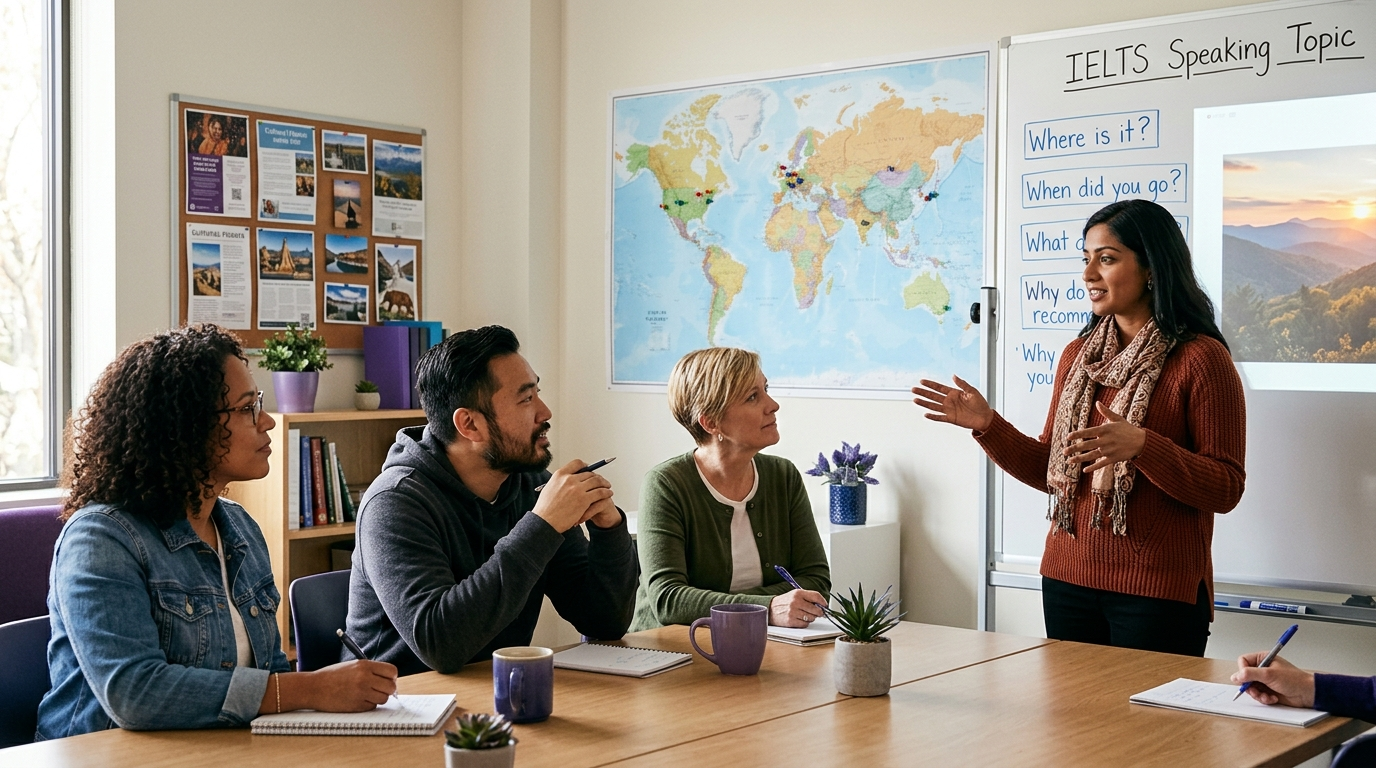
Carte aide-mémoire de la deuxième partie
Describe a place you have travelled to that you would like to recommend to others
Il faudrait dire :
- Qu'est-ce que c'est
- Où c'est
- Ce que tu as vu et fait là-bas
- Et expliquez pourquoi vous aimeriez le recommander à d’autres
Vous disposerez d'une à deux minutes pour aborder ce sujet.
Lire la transcription complète
I'd like to recommend the Lake District, a national park in north‑west England, famous for its lakes and craggy fells. It’s a place where countryside feels dramatic yet welcoming; writers like Wordsworth drew inspiration from the scenery and you can still sense that literary atmosphere. It’s situated in Cumbria, roughly two hours by train from Manchester and easily reached by car, which makes it practical for a long weekend. For instance, I took a train to Oxenholme and then a short bus ride into Ambleside. While I was there I did a mix of things: walked along the shores of Windermere, took a small boat trip, and climbed to the summit of Helvellyn via Striding Edge. I also visited cosy tea rooms in Grasmere and went to a little museum about local history. In spring the hills are full of wildflowers and you can often spot red squirrels and herons, which made my morning walks feel special. There are also farmers’ markets and independent shops where you can buy local cheese and crafts. I’d recommend it because it offers something for everyone — from gentle lakeside strolls to challenging hikes — and the scenery feels rejuvenating. In addition, the local food and friendly accommodation make it easy to relax after a day outdoors, so it’s great whether you’re travelling with family, friends or alone.
État de préparation : cycle thématique prévu. Cette ressource de pratique indépendante n'est pas un document officiel de l'IELTS et les questions de votre test peuvent être différentes. Comment les sujets sont étiquetés.
Questions de discussion de la troisième partie
Déplacez une question à la fois : écoutez, répondez, comparez et réessayez. Le texte complet de la question reste dans la page HTML pour l'accessibilité et la recherche.
- 01Where do people in your country often go for holidays?
- 02What is the ideal length for a holiday?
- 03How do people usually plan holidays?
- 04Is it important to plan a holiday ahead?
- 05Why do many countries try to attract people to visit?
- 06How do people decide when to travel?
Voir le sujet avant de parler
Utilisez les images comme invites à idées. Décrivez ce que vous remarquez, reliez-le à votre expérience, puis répondez à la vraie question.


Des réponses modèles, entendues côte à côte
Commencez par la réponse la plus simple, changez Band pour entendre comment la même tâche peut être développée, puis enregistrez une réponse personnelle. Ce sont des exemples pédagogiques, pas des réponses officielles ni des garanties de scores.
Partie 2 — Modèle de réponse
Part 2 cue-card response
I want to recommend the Lake District in north‑west England. It’s a national park with lots of lakes, hills and small villages. I went there last year and did walks along Windermere, took a short boat trip and visited Grasmere. I also ate in a small pub and enjoyed the views from a hill top. I would recommend it because it’s easy to get to from many cities, it has different things for different people and it’s a good place to relax. Even if you don’t like tough walking, there are gentle paths and cafés to sit in.
I'd like to recommend the Lake District, a national park in north‑west England, famous for its lakes and craggy fells. It’s a place where countryside feels dramatic yet welcoming; writers like Wordsworth drew inspiration from the scenery and you can still sense that literary atmosphere. It’s situated in Cumbria, roughly two hours by train from Manchester and easily reached by car, which makes it practical for a long weekend. For instance, I took a train to Oxenholme and then a short bus ride into Ambleside. While I was there I did a mix of things: walked along the shores of Windermere, took a small boat trip, and climbed to the summit of Helvellyn via Striding Edge. I also visited cosy tea rooms in Grasmere and went to a little museum about local history. In spring the hills are full of wildflowers and you can often spot red squirrels and herons, which made my morning walks feel special. There are also farmers’ markets and independent shops where you can buy local cheese and crafts. I’d recommend it because it offers something for everyone — from gentle lakeside strolls to challenging hikes — and the scenery feels rejuvenating. In addition, the local food and friendly accommodation make it easy to relax after a day outdoors, so it’s great whether you’re travelling with family, friends or alone.
Partie 3 — Modèle de réponses
Where do people in your country often go for holidays?
People often go to the coast, like beaches, or to the countryside for a week or two. Many families visit seaside towns in the summer, and quite a few go abroad to Europe for cheaper flights. Some people prefer city breaks to visit museums and shops. Visiting relatives is also common during big holidays.
On the whole, people choose a mix of beach resorts, countryside escapes and European city breaks. For example, families often head to seaside towns in summer for sun and shallow waters, while young couples might pick a short city break to see galleries or theatre. There’s also a growing trend for staycations, where people explore national parks or coastal paths rather than flying, often because it’s more convenient or cheaper. Work patterns and school terms still shape most choices, though.
What is the ideal length for a holiday?
I think one to two weeks is ideal for a holiday. A few days is OK for a short trip, but if you go far it’s better to stay longer so you don’t waste time travelling. Two weeks lets you relax properly and see the main things.
It really depends on the type of trip, but generally one to two weeks is ideal. A long weekend suits city breaks or short visits, whereas two weeks works well for overseas travel because you can recover from jet lag and explore at a relaxed pace. For adventurous trips or multi‑stop tours, I’d say two weeks or more so you’re not rushing from place to place.
How do people usually plan holidays?
People usually plan holidays online now. They search for flights and hotels and read reviews. Some still use travel agents to book a whole package. Friends and family often give suggestions too.
Most people start planning online, comparing flights, accommodation and traveller reviews on several websites, and often use apps to track prices. Some prefer package holidays from agents for convenience, especially when travelling with children or to less familiar destinations. Others piece together their own itineraries, booking flexible tickets and using maps and blogs for local tips. Social media and personal recommendations also shape choices these days.
Is it important to plan a holiday ahead?
Yes, it’s important to plan ahead for things like flights, visas and accommodation. If you plan early you can get better prices. But some people like to be spontaneous and book at the last minute.
Planning ahead is generally important because it secures better prices, availability and necessary documents like visas or permits. It also reduces stress and helps you make an efficient itinerary, especially in peak season. That said, leaving room for spontaneity can be valuable too; a mix of advance planning and flexibility often works best.
Why do many countries try to attract people to visit?
Countries try to attract visitors because tourism brings money and jobs. It helps local businesses and sometimes pays for services. Also, tourists can learn about the country’s culture.
Many countries actively promote tourism because it brings significant economic benefits, creates jobs and supports local businesses such as hotels, restaurants and transport. Beyond economics, tourism is used as a form of soft power to raise a country’s profile and share cultural heritage. However, governments must also manage environmental impact and overcrowding, so promotion is often balanced with sustainability plans.
How do people decide when to travel?
People decide when to travel by looking at school holidays, work leave and the weather. Price is important too — some travel in low season to save money. Special events or festivals also determine timing.
Decisions about timing are shaped by practical constraints like school terms, work leave and favourable weather, but people also look for value by travelling in shoulder or off‑peak seasons. Events, festivals or local celebrations can strongly influence dates, as can personal commitments and even seasonal wildlife or crop cycles if someone is going for nature or food experiences. Many people also watch for deals and book when fares drop.
Statut de la pratique : sujet archivé d'un cycle précédent de banque de questions. Elle reste utile pour la pratique des compétences mais n'est pas présentée comme une question d'examen actuelle ou garantie. Comment les sujets sont étiquetés.
Comment répondre Décrivez un endroit où vous avez voyagé et que vous aimeriez recommander à d'autres Questions orales IELTS
Pour la carte aide-mémoire Décrivez un endroit où vous avez voyagé et que vous aimeriez recommander à d'autres, utilisez la minute de préparation pour construire un itinéraire à travers l'exposé. Choisissez un sujet clair, ajoutez deux moments ou détails spécifiques et terminez par pourquoi c'est important. Utilisez ensuite les questions liées de la partie 3 pour pratiquer des explications et des comparaisons plus larges.
Invites de la carte aide-mémoire :
- Qu'est-ce que c'est
- Où c'est
- Ce que tu as vu et fait là-bas
- Et expliquez pourquoi vous aimeriez le recommander à d’autres
- Ouverture : identifier la personne, le lieu, l'objet ou l'événement.
- Développement : décrire deux détails ou moments dans un ordre logique.
- Extension : expliquer une raison, un résultat, une comparaison ou un problème.
- Réflexion : terminez par pourquoi le sujet est mémorable ou important.
Approche question par question
| Question pratique | Mouvement de réponse utile |
|---|---|
| Where do people in your country often go for holidays? | Donnez une réponse directe, une raison et un court exemple sans mémoriser un script. |
| What is the ideal length for a holiday? | Nommez d’abord la chose, puis décrivez une fonctionnalité ou un exemple spécifique. |
| How do people usually plan holidays? | Décrivez le processus ou la différence dans un ordre clair et ajoutez un résultat. |
| Is it important to plan a holiday ahead? | Répondez directement, donnez une raison et ajoutez un détail personnel naturel. |
Focus sur le vocabulaire
Le langage utile déjà démontré dans les réponses modèles comprend staycation, city break, seaside resort, long weekend, jet lag, at a relaxed pace, itinerary, flexible tickets. Apprenez chaque signification et un partenariat de mots naturel, puis utilisez l'élément dans une nouvelle réponse au lieu de copier un script complet.
Erreurs courantes à éviter
- Donner une réponse mémorisée qui ne répond que partiellement à la question.
- Ajouter du vocabulaire difficile sans vérifier le sens ou la collocation.
- Redémarrer après chaque erreur au lieu de corriger brièvement et de continuer.
- Lisez la réponse modèle avant d’enregistrer votre propre première tentative.
Décrivez un endroit où vous avez voyagé et que vous aimeriez recommander à d'autres. FAQ
Comment dois-je utiliser la minute de préparation de la carte aide-mémoire Décrire un endroit où vous avez voyagé et que vous aimeriez recommander à d'autres ?
Écrivez des mots-clés pour une introduction, deux ou trois détails et une réflexion finale. N'essayez pas d'écrire des phrases complètes.
Dois-je couvrir chaque puce de la carte signalétique ?
Les invites vous aident à organiser la discussion. Les couvrir est utile, mais une réponse cohérente d’une à deux minutes compte plus que de cocher mécaniquement chaque ligne.
Quel est le lien entre les questions de la partie 3 et la partie 2 ?
Ils développent le même thème général à travers des raisons, des comparaisons, des effets sociaux ou des possibilités futures, de sorte que les réponses nécessitent normalement plus d'explications que la première partie.
