
IELTS Speaking Parte 2 y 3: Describe a boring place

Tarjeta de referencia de la parte 2
Describe a boring place
Deberías decir:
- donde esta
- ¿Con quién fuiste allí?
- lo que hiciste allí
- ¿Por qué crees que es un lugar aburrido?
Tendrás uno o dos minutos para hablar sobre este tema.
Lea la transcripción completa
One place I found really boring was the local council office in my town. I went there with my mother to renew some paperwork for an elderly relative, and we had to queue for nearly an hour. The office itself is a small, grey room with rows of plastic chairs, a flickering fluorescent light and a TV that only shows public service announcements; it feels like it drains any energy from people. While we were there I filled in forms, listened to other people's dull conversations about appointments, and tried to read a leaflet about recycling that was full of dense, bureaucratic language; there wasn't much else to do. It felt boring because everything was slow and repetitive, and there was no attempt to make the place welcoming or interesting — no displays, no music, nothing to engage you. Also the tasks you're doing are tedious and mechanical, so time slows down. For example, at one point a woman beside me started a crossword and then fell asleep. There was a faint smell of cleaning fluid and the heating made the air stale, which didn't help. The staff spoke in monotone and seemed rushed, so there was no friendly chat to pass the time. Altogether it was one of those experiences that makes you check your watch every few minutes.
Estado de preparación: ciclo de tema previsto. Este recurso de práctica independiente no es un documento oficial del IELTS y las preguntas de su examen pueden ser diferentes. Cómo se etiquetan los temas.
Preguntas de discusión de la parte 3
Mueva una pregunta a la vez: escuche, responda, compare y vuelva a intentarlo. El texto completo de la pregunta permanece en la página HTML para accesibilidad y búsqueda.
- 01Why do most children think education is boring?
- 02Why aren't young people willing to listen to the experiences of older people?
- 03What can people do when they feel bored?
- 04Why are some teachers' classes boring? Are there any solutions?
- 05Why do some young people feel bored when talking with old people?
- 06Do most people think news about celebrities is boring?
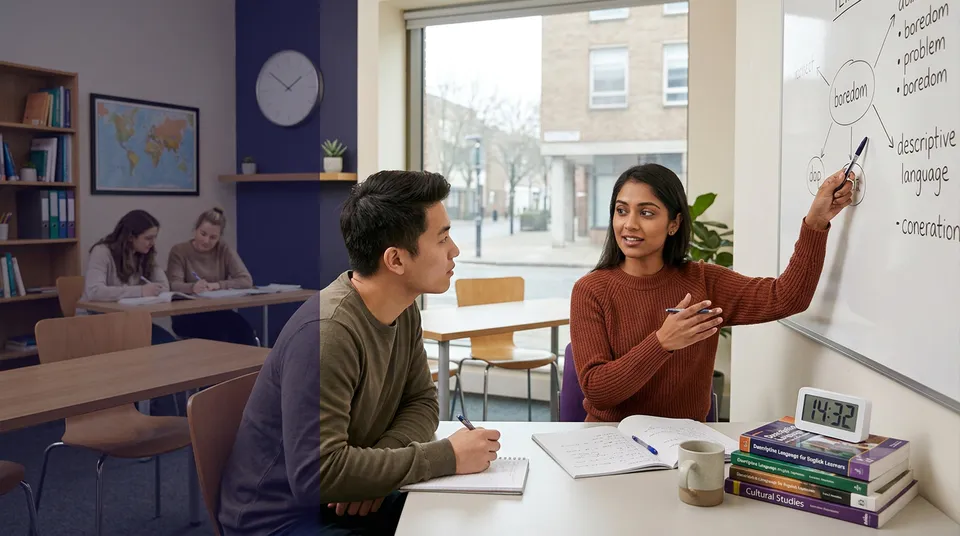
Vea el tema antes de hablar.
Utilice las imágenes como sugerencias de ideas. Describe lo que notas, conéctalo con tu experiencia y luego responde la pregunta real.

Respuestas modelo, escuchadas una al lado de la otra
Comience con la respuesta más simple, cambie Band para escuchar cómo se puede desarrollar la misma tarea y luego registre una respuesta personal. Estos son ejemplos de enseñanza, no respuestas oficiales ni garantías de puntuación.
Parte 2: Respuesta modelo
Part 2 cue-card response
I want to describe a place I found boring: the local council office. I went there with my mum to sort out some paperwork for an elderly relative. We sat in the waiting room and waited a long time. I filled in forms, looked at some outdated posters on the wall and chatted a little with my mum. It was boring because nothing happened, the chairs were hard and the staff moved slowly. There was nothing to do, no magazines or music. Time passed very slowly and I kept checking the door and my phone.
One place I found really boring was the local council office in my town. I went there with my mother to renew some paperwork for an elderly relative, and we had to queue for nearly an hour. The office itself is a small, grey room with rows of plastic chairs, a flickering fluorescent light and a TV that only shows public service announcements; it feels like it drains any energy from people. While we were there I filled in forms, listened to other people's dull conversations about appointments, and tried to read a leaflet about recycling that was full of dense, bureaucratic language; there wasn't much else to do. It felt boring because everything was slow and repetitive, and there was no attempt to make the place welcoming or interesting — no displays, no music, nothing to engage you. Also the tasks you're doing are tedious and mechanical, so time slows down. For example, at one point a woman beside me started a crossword and then fell asleep. There was a faint smell of cleaning fluid and the heating made the air stale, which didn't help. The staff spoke in monotone and seemed rushed, so there was no friendly chat to pass the time. Altogether it was one of those experiences that makes you check your watch every few minutes.
Parte 3: Respuestas modelo
Why do most children think education is boring?
Children often think education is boring because lessons can be the same every day. Teachers might talk for a long time and pupils just listen. Many kids would prefer more games or practical work. Also tests make school feel like chores.
Many children find school dull because the system still relies heavily on rote learning and frequent testing, which reduces learning to memorising facts. When lessons are teacher-centred and there’s little hands-on activity, pupils quickly disengage. Short attention spans, fuelled by fast-paced digital media, make slow-paced lectures seem especially tedious. By contrast, project-based tasks or practical experiments can make topics feel relevant and spark curiosity — for instance, a science lesson with a simple experiment often holds attention far better than a long explanation.
Why aren't young people willing to listen to the experiences of older people?
Young people sometimes don't want to listen to older people because they think older people are out of touch. They prefer talking to friends their own age. Also older people can tell long stories that seem boring to youth.
There are a few reasons why younger people may not listen to the older generation: a perceived gap in values, different cultural references and the speed of change in technology. Older people may tell long, detailed stories that don't connect with modern concerns, so younger listeners switch off. Sometimes it's also about attitude — young people want to feel respected and may ignore advice if it sounds like lecturing. However, when older people adapt their language and focus on shared experiences, conversations become much more rewarding for both sides.
What can people do when they feel bored?
If someone feels bored they can read a book, go for a walk, call a friend or watch a film. Doing a hobby helps. Even a short exercise session can change your mood.
When boredom strikes, a good approach is to change your environment or start a small, focused task. Learning a new skill in short bursts, going for a brisk walk, or trying a ten-minute writing sprint can quickly refresh your mind. Volunteering or joining a local class also gives purpose and social contact, which beats passive scrolling. Mindfulness techniques can help you tolerate quiet moments and sometimes boredom is a cue to try something new rather than a problem to be immediately fixed.
Why are some teachers' classes boring? Are there any solutions?
Some teachers are boring because they just read from the board and speak in a flat voice. They don't use activities or ask students to join in. One way to fix this is to make classes more interactive, with group work or games.
Classes become boring when teaching is monotonous, teacher-centred and lacks variety; this often happens because of large classes, heavy curricula or limited teacher training. There are practical solutions: use active-learning techniques, flip parts of the lesson so students prepare at home and do practical tasks in class, and vary the pace with short activities. Regular formative checks and using storytelling or real-world examples can also make material more memorable. These changes require planning, but they make lessons far more engaging in the long run.
Why do some young people feel bored when talking with old people?
Young people can get bored talking to older people because their interests are different. Old people repeat stories and speak more slowly. Young people like faster, more lively chats.
Boredom in intergenerational conversations often comes from a mismatch of topics and tempo: older speakers may focus on past events or detailed memories, while younger people prefer quick, topical exchanges. Technology also plays a part, since younger people are used to rapid, multimedia communication. That said, boredom can be reduced if both ask open questions and look for common ground — for example, discussing music, food or local events can bridge the gap and create a lively exchange.
Do most people think news about celebrities is boring?
Some people think celebrity news is boring because it's not important and it's the same stories again and again. But other people enjoy it as light entertainment. It depends on the person.
Many find celebrity news trivial because it tends to be repetitive, sensational and lacking in depth, so it doesn't provide real information about society. However, celebrity coverage also serves as light entertainment and social currency — people often enjoy gossip or follow stars for fashion and lifestyle ideas. Algorithms on social media amplify this content, making it seem more important than it is. Personally, I think it's fine in small doses, but too much can crowd out more important news.
Cómo responder las preguntas de Describe un lugar aburrido del IELTS Speaking
Para la tarjeta de referencia Describe un lugar aburrido, utiliza el minuto de preparación para construir una ruta a lo largo de la charla. Elija un tema claro, agregue dos momentos o detalles específicos y termine explicando por qué es importante. Luego utilice las preguntas vinculadas de la Parte 3 para practicar explicaciones y comparaciones más amplias.
Indicaciones de la tarjeta de referencia:
- donde esta
- ¿Con quién fuiste allí?
- lo que hiciste allí
- ¿Por qué crees que es un lugar aburrido?
- Apertura: identificar a la persona, lugar, objeto o evento.
- Desarrollo: describir dos detalles o momentos en un orden lógico.
- Ampliación: explicar un motivo, resultado, comparación o problema.
- Reflexión: terminar con por qué el tema es memorable o importante.
Enfoque pregunta por pregunta
| pregunta de práctica | movimiento de respuesta útil |
|---|---|
| Why do most children think education is boring? | Responda con una causa principal y luego apóyela con un ejemplo concreto. |
| Why aren't young people willing to listen to the experiences of older people? | Responda con una causa principal y luego apóyela con un ejemplo concreto. |
| What can people do when they feel bored? | Primero nombra el objeto y luego describe una característica o ejemplo específico. |
| Why are some teachers' classes boring? Are there any solutions? | Responda con una causa principal y luego apóyela con un ejemplo concreto. |
Enfoque de vocabulario
El lenguaje útil ya demostrado en las respuestas modelo incluye rote learning, project-based, engage (engagement), out of touch, cultural references, switch off, brisk walk, ten-minute sprint. Aprenda cada significado y una asociación natural de palabras, luego use el elemento en una respuesta nueva en lugar de copiar un guión completo.
Errores comunes a evitar
- Dar una respuesta memorizada que responda sólo parcialmente a la pregunta.
- Agregar vocabulario difícil sin verificar el significado o la colocación.
- Reiniciar después de cada error en lugar de corregir brevemente y continuar.
- Leer la respuesta modelo antes de grabar su primer intento.
Describe un lugar aburrido, practica las preguntas frecuentes
¿Cómo debo utilizar el minuto de preparación de la tarjeta de referencia Describe un lugar aburrido?
Escribe palabras clave para una apertura, dos o tres detalles y una reflexión final. No intentes escribir oraciones completas.
¿Tengo que cubrir cada viñeta de la tarjeta de referencia?
Las indicaciones le ayudarán a organizar la charla. Cubrirlos es útil, pero una respuesta coherente de uno a dos minutos es más importante que marcar mecánicamente cada línea.
¿Cómo se conectan las preguntas de la Parte 3 con la Parte 2?
Desarrollan el mismo tema amplio a través de razones, comparaciones, efectos sociales o posibilidades futuras, por lo que las respuestas normalmente necesitan más explicaciones que la Parte 1.
