
Palestra IELTS Parte 2 e 3: Describe a boring place

Cartão de dicas da parte 2
Describe a boring place
Você deveria dizer:
- Onde está
- Com quem você foi lá
- O que você fez lá
- Por que você acha que é um lugar chato
Você terá de um a dois minutos para falar sobre este assunto.
Leia a transcrição completa
One place I found really boring was the local council office in my town. I went there with my mother to renew some paperwork for an elderly relative, and we had to queue for nearly an hour. The office itself is a small, grey room with rows of plastic chairs, a flickering fluorescent light and a TV that only shows public service announcements; it feels like it drains any energy from people. While we were there I filled in forms, listened to other people's dull conversations about appointments, and tried to read a leaflet about recycling that was full of dense, bureaucratic language; there wasn't much else to do. It felt boring because everything was slow and repetitive, and there was no attempt to make the place welcoming or interesting — no displays, no music, nothing to engage you. Also the tasks you're doing are tedious and mechanical, so time slows down. For example, at one point a woman beside me started a crossword and then fell asleep. There was a faint smell of cleaning fluid and the heating made the air stale, which didn't help. The staff spoke in monotone and seemed rushed, so there was no friendly chat to pass the time. Altogether it was one of those experiences that makes you check your watch every few minutes.
Status de preparação: Ciclo de tópico previsto. Este recurso de prática independente não é um documento oficial do IELTS e as perguntas do seu teste podem ser diferentes. Como os tópicos são rotulados.
Questões para discussão da Parte 3
Mova uma pergunta de cada vez: ouça, responda, compare e tente novamente. O texto completo da pergunta permanece na página HTML para acessibilidade e pesquisa.
- 01Why do most children think education is boring?
- 02Why aren't young people willing to listen to the experiences of older people?
- 03What can people do when they feel bored?
- 04Why are some teachers' classes boring? Are there any solutions?
- 05Why do some young people feel bored when talking with old people?
- 06Do most people think news about celebrities is boring?
Veja o tópico antes de falar
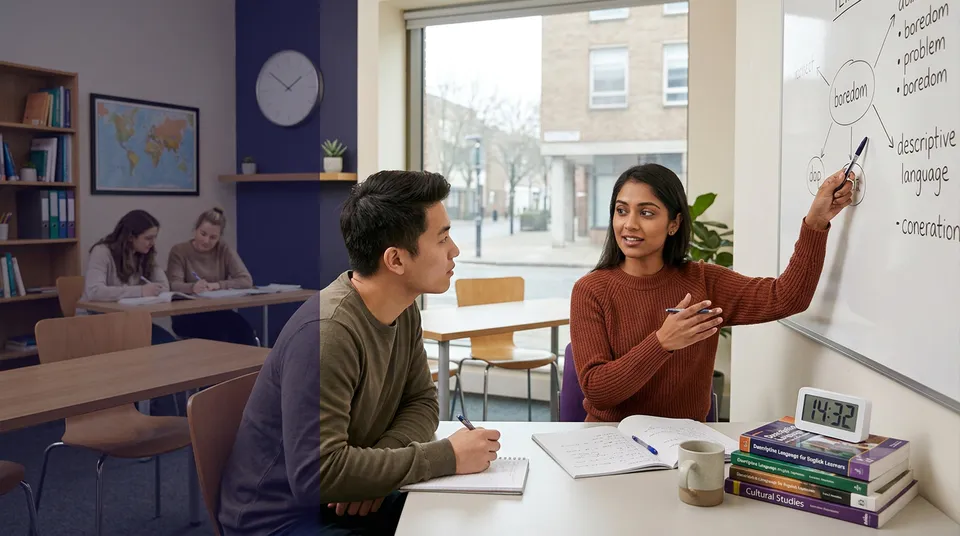
Use as imagens como sugestões de ideias. Descreva o que você percebe, conecte-o à sua experiência e responda à verdadeira pergunta.

Respostas modelo, ouvidas lado a lado
Comece com a resposta mais simples, mude Band para ouvir como a mesma tarefa pode ser desenvolvida e depois registre uma resposta pessoal. Estes são exemplos didáticos, não respostas oficiais ou garantias de pontuação.
Parte 2 – Resposta do Modelo
Part 2 cue-card response
I want to describe a place I found boring: the local council office. I went there with my mum to sort out some paperwork for an elderly relative. We sat in the waiting room and waited a long time. I filled in forms, looked at some outdated posters on the wall and chatted a little with my mum. It was boring because nothing happened, the chairs were hard and the staff moved slowly. There was nothing to do, no magazines or music. Time passed very slowly and I kept checking the door and my phone.
One place I found really boring was the local council office in my town. I went there with my mother to renew some paperwork for an elderly relative, and we had to queue for nearly an hour. The office itself is a small, grey room with rows of plastic chairs, a flickering fluorescent light and a TV that only shows public service announcements; it feels like it drains any energy from people. While we were there I filled in forms, listened to other people's dull conversations about appointments, and tried to read a leaflet about recycling that was full of dense, bureaucratic language; there wasn't much else to do. It felt boring because everything was slow and repetitive, and there was no attempt to make the place welcoming or interesting — no displays, no music, nothing to engage you. Also the tasks you're doing are tedious and mechanical, so time slows down. For example, at one point a woman beside me started a crossword and then fell asleep. There was a faint smell of cleaning fluid and the heating made the air stale, which didn't help. The staff spoke in monotone and seemed rushed, so there was no friendly chat to pass the time. Altogether it was one of those experiences that makes you check your watch every few minutes.
Parte 3 – Respostas do Modelo
Why do most children think education is boring?
Children often think education is boring because lessons can be the same every day. Teachers might talk for a long time and pupils just listen. Many kids would prefer more games or practical work. Also tests make school feel like chores.
Many children find school dull because the system still relies heavily on rote learning and frequent testing, which reduces learning to memorising facts. When lessons are teacher-centred and there’s little hands-on activity, pupils quickly disengage. Short attention spans, fuelled by fast-paced digital media, make slow-paced lectures seem especially tedious. By contrast, project-based tasks or practical experiments can make topics feel relevant and spark curiosity — for instance, a science lesson with a simple experiment often holds attention far better than a long explanation.
Why aren't young people willing to listen to the experiences of older people?
Young people sometimes don't want to listen to older people because they think older people are out of touch. They prefer talking to friends their own age. Also older people can tell long stories that seem boring to youth.
There are a few reasons why younger people may not listen to the older generation: a perceived gap in values, different cultural references and the speed of change in technology. Older people may tell long, detailed stories that don't connect with modern concerns, so younger listeners switch off. Sometimes it's also about attitude — young people want to feel respected and may ignore advice if it sounds like lecturing. However, when older people adapt their language and focus on shared experiences, conversations become much more rewarding for both sides.
What can people do when they feel bored?
If someone feels bored they can read a book, go for a walk, call a friend or watch a film. Doing a hobby helps. Even a short exercise session can change your mood.
When boredom strikes, a good approach is to change your environment or start a small, focused task. Learning a new skill in short bursts, going for a brisk walk, or trying a ten-minute writing sprint can quickly refresh your mind. Volunteering or joining a local class also gives purpose and social contact, which beats passive scrolling. Mindfulness techniques can help you tolerate quiet moments and sometimes boredom is a cue to try something new rather than a problem to be immediately fixed.
Why are some teachers' classes boring? Are there any solutions?
Some teachers are boring because they just read from the board and speak in a flat voice. They don't use activities or ask students to join in. One way to fix this is to make classes more interactive, with group work or games.
Classes become boring when teaching is monotonous, teacher-centred and lacks variety; this often happens because of large classes, heavy curricula or limited teacher training. There are practical solutions: use active-learning techniques, flip parts of the lesson so students prepare at home and do practical tasks in class, and vary the pace with short activities. Regular formative checks and using storytelling or real-world examples can also make material more memorable. These changes require planning, but they make lessons far more engaging in the long run.
Why do some young people feel bored when talking with old people?
Young people can get bored talking to older people because their interests are different. Old people repeat stories and speak more slowly. Young people like faster, more lively chats.
Boredom in intergenerational conversations often comes from a mismatch of topics and tempo: older speakers may focus on past events or detailed memories, while younger people prefer quick, topical exchanges. Technology also plays a part, since younger people are used to rapid, multimedia communication. That said, boredom can be reduced if both ask open questions and look for common ground — for example, discussing music, food or local events can bridge the gap and create a lively exchange.
Do most people think news about celebrities is boring?
Some people think celebrity news is boring because it's not important and it's the same stories again and again. But other people enjoy it as light entertainment. It depends on the person.
Many find celebrity news trivial because it tends to be repetitive, sensational and lacking in depth, so it doesn't provide real information about society. However, celebrity coverage also serves as light entertainment and social currency — people often enjoy gossip or follow stars for fashion and lifestyle ideas. Algorithms on social media amplify this content, making it seem more important than it is. Personally, I think it's fine in small doses, but too much can crowd out more important news.
Como responder Descreva um lugar chato Perguntas do IELTS Speaking
Para o cartão de dicas Descreva um lugar chato, use o minuto de preparação para construir um roteiro durante a palestra. Escolha um assunto claro, adicione dois momentos ou detalhes específicos e termine explicando por que é importante. Em seguida, use as perguntas vinculadas da Parte 3 para praticar explicações e comparações mais amplas.
Solicitações do cartão de sugestão:
- Onde está
- Com quem você foi lá
- O que você fez lá
- Por que você acha que é um lugar chato
- Abertura: identificar a pessoa, lugar, objeto ou evento.
- Desenvolvimento: descreva dois detalhes ou momentos em uma ordem lógica.
- Extensão: explique um motivo, resultado, comparação ou problema.
- Reflexão: finalize explicando por que o assunto é memorável ou importante.
Abordagem pergunta por pergunta
| Pergunta prática | Movimento de resposta útil |
|---|---|
| Why do most children think education is boring? | Responda com uma causa principal e depois apoie-a com um exemplo concreto. |
| Why aren't young people willing to listen to the experiences of older people? | Responda com uma causa principal e depois apoie-a com um exemplo concreto. |
| What can people do when they feel bored? | Nomeie a coisa primeiro e depois descreva um recurso ou exemplo específico. |
| Why are some teachers' classes boring? Are there any solutions? | Responda com uma causa principal e depois apoie-a com um exemplo concreto. |
Foco no vocabulário
A linguagem útil já demonstrada nas respostas do modelo inclui rote learning, project-based, engage (engagement), out of touch, cultural references, switch off, brisk walk, ten-minute sprint. Aprenda cada significado e uma parceria natural de palavras e, em seguida, use o item em uma nova resposta em vez de copiar um script completo.
Erros comuns a evitar
- Dar uma resposta memorizada que responde apenas parcialmente à pergunta.
- Adicionar vocabulário difícil sem verificar o significado ou a colocação.
- Reiniciar após cada erro em vez de corrigir brevemente e continuar.
- Lendo a resposta do modelo antes de gravar sua primeira tentativa.
Descreva as perguntas frequentes sobre a prática de um lugar chato
Como devo usar o minuto de preparação do cartão de dicas Descreva um lugar chato?
Escreva palavras-chave para uma abertura, dois ou três detalhes e uma reflexão final. Não tente escrever frases completas.
Tenho que cobrir todos os marcadores do cartão de sinalização?
As instruções ajudam você a organizar a palestra. Cobri-los é útil, mas uma resposta coerente de um a dois minutos é mais importante do que marcar mecanicamente cada linha.
Como as perguntas da Parte 3 estão conectadas à Parte 2?
Desenvolvem o mesmo tema amplo através de razões, comparações, efeitos sociais ou possibilidades futuras, pelo que as respostas normalmente necessitam de mais explicações do que a Parte 1.
