
Practise IELTS Speaking with free topics, model answers and browser recording. Choose a full realtime mock with an AI examiner when you want structured practice and a report. Web mocks require Apple sign-in and Pro.
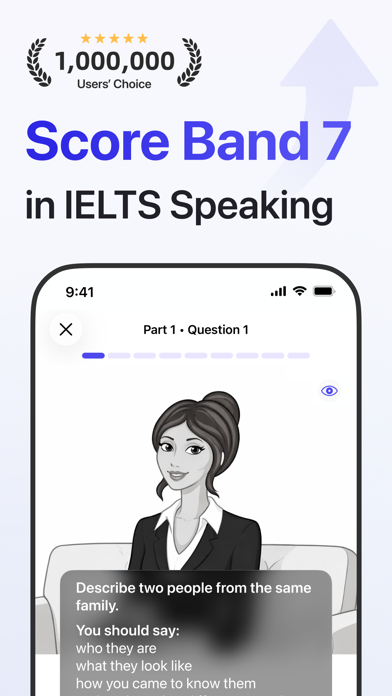
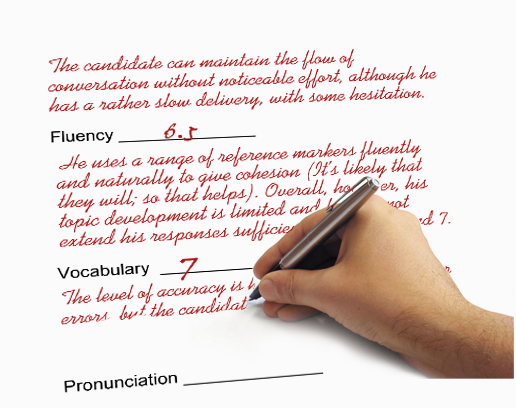
Free topic practice record and listen back
Pro web mocks Apple sign-in required
Dated collections check source dates
Band 6 → 7 model answer pairs
Public practice is free. Full realtime web mocks require Apple sign-in and an active Pro membership.
| Feature | Access | What you get |
|---|---|---|
| Topics, model answers and study guides | Free; no account required | Read and practise independently |
| Browser recording and playback | Free; microphone permission required | Record and review your own answer; no AI score |
| Public sample report | Free; no sign-in required | Illustrative feedback and a worked improvement example |
| Full realtime web mock test | Apple sign-in and active Pro membership | A three-part test with an AI examiner and a practice report |
| iPhone and iPad app | Free download; in-app purchases | Check the in-app offer for included practice, allowances and price |
Free download does not mean unlimited free AI marking. No universal free AI-test allowance is published here. Check the offer in the app before starting a paid feature. Web Pro access uses the same Apple account; subscribe in the iPhone app, then return to the website.
Start free topic practiceView a sample reportCompare access and pricing
From mock test to score report to targeted practice — here's what your daily 10 minutes looks like.
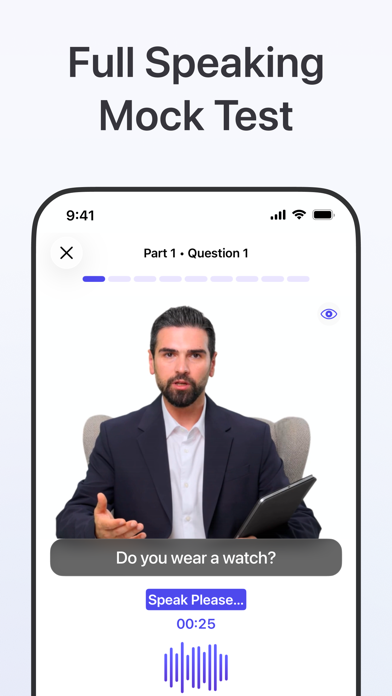
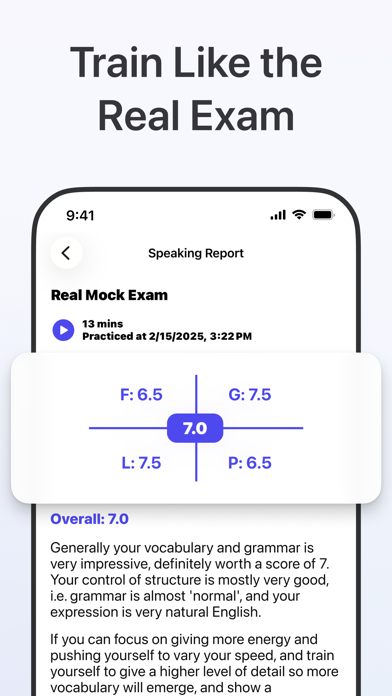
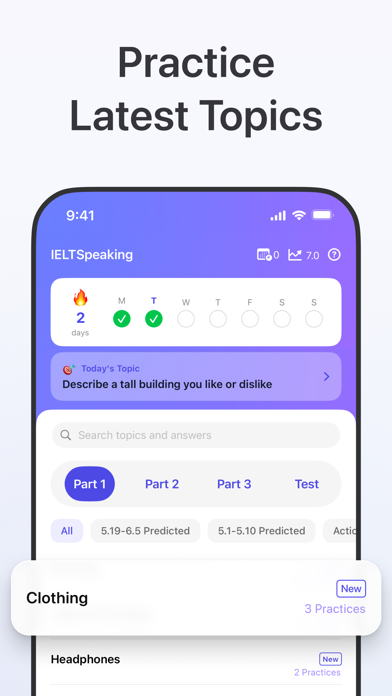
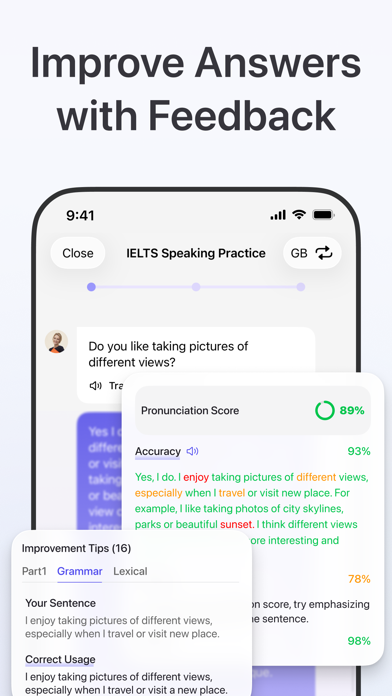
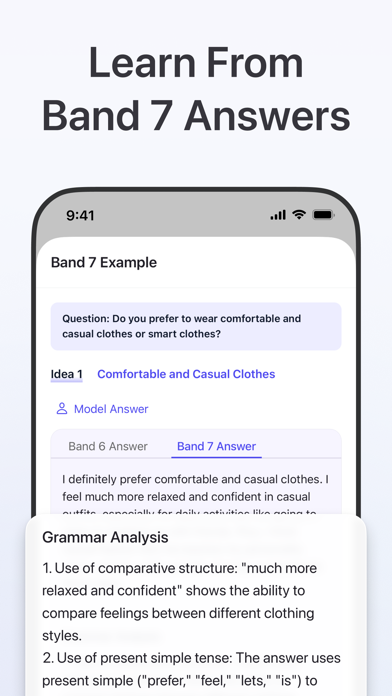
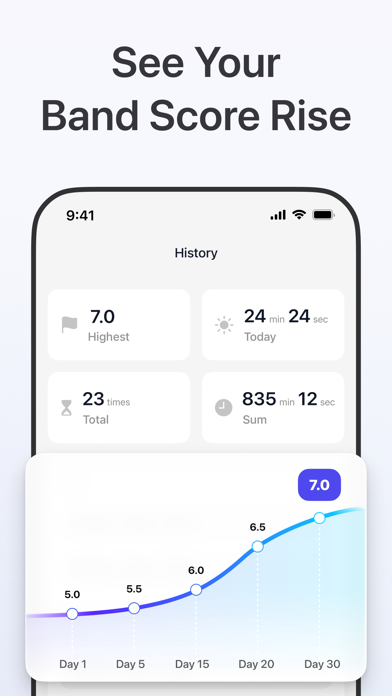
Four steps from "I don't know my level" to a confident exam-day performance.
Sit the complete IELTS Speaking test — Part 1, 2 and 3 — with a video examiner, exactly like exam day.
Get an instant report grading Fluency, Grammar, Lexical resource and Pronunciation, with an overall band and examiner-style feedback.
Drill Part 1, 2 or 3 with the AI examiner, get pronunciation scores and grammar fixes, and compare Band 6 vs Band 7 model answers.
Track comparable sessions on your progress chart, listen for audible changes and choose the next skill to practise.
Use dated topic collections for practice, with clear source and coverage information.
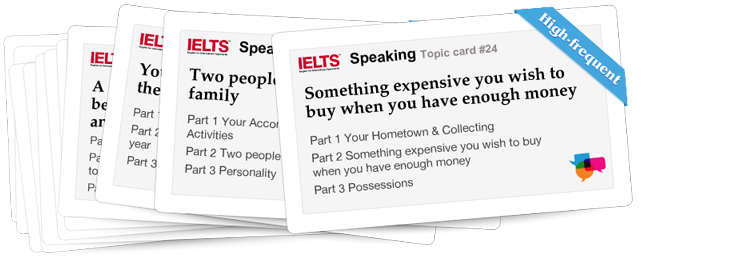
Check the collection date, record an answer for free and compare model answers. Prediction labels do not guarantee questions in your exam.
Browse practice topicsPractical answers to the questions every candidate asks — and how to put them into practice.
Understand the IELTS Speaking test format, Parts 1, 2 and 3, timing, questions, band scores and a practical 7-day preparation plan.
Read the guide →A 20-minute solo routine using timed answers, free browser recording and focused review, with clear limits on self-assessment and AI scoring.
Read the guide →Master IELTS Speaking Part 1: format, answer length, a natural answer structure, common topics, Band 7 language and a timed practice routine.
Read the guide →Learn IELTS Speaking Part 3 format, answer structures, idea development, comparison and speculation, with examples and a timed recording routine.
Read the guide →Know what to expect on IELTS Speaking test day: identity checks, the three test parts, timing, recording, video-call delivery and a calm final checklist.
Read the guide →There is no official word count. Learn practical IELTS Speaking answer lengths for Parts 1, 2 and 3 and how to know when to extend or stop.
Read the guide →Find and fix common IELTS Speaking mistakes: memorised answers, weak development, fillers, vocabulary forcing, grammar errors and poor recording review.
Read the guide →Review an IELTS Speaking recording with a two-pass checklist for fluency, vocabulary, grammar and pronunciation, then re-record one focused change.
Read the guide →Choose by your task: flexible conversation and explanations, free recording, or a structured Pro mock with a saved report. Includes a practice prompt and comparison checklist.
Read the guide →Match your IELTS Speaking problem to free self-review, a structured AI mock or focused human feedback, before spending money.
Read the guide →A worked example for checking a report, choosing one evidenced weakness and retesting it on fresh IELTS Speaking questions.
Read the guide →The IELTS Speaking test is an 11-14 minute recorded interview with three parts: familiar questions in Part 1, a prepared long turn in Part 2 and a broader discussion in Part 3. Four equally weighted criteria produce the Speaking band. Learn more →
Yes. Timed answers and careful recording review give you useful practice. Add external feedback when you cannot diagnose or correct a repeated problem. Learn more →
Answer directly, then add one relevant reason, detail, example or contrast. There is no official sentence count; the aim is a natural, complete response rather than a one-word answer or memorised speech. Learn more →
State a clear position, explain the main reason and support it with an example, consequence or comparison. Add nuance only when it makes the answer more accurate. Learn more →
After the test centre's identity process, you complete a recorded 11-14 minute interview: familiar questions in Part 1, a prepared long turn in Part 2 and a broader discussion in Part 3. Learn more →
There is no official word or sentence target. Part 1 needs short developed replies, Part 2 has a one-to-two-minute long turn, and Part 3 needs enough space for a supported opinion. Learn more →
Common patterns include memorised or irrelevant answers, weak development, repeated fillers and restarts, forced vocabulary, uncontrolled grammar and practice with no recording review. Learn more →
Listen once for relevance and clarity, then inspect one scoring criterion with timestamps or a short transcript. Choose one repair, re-record once and retest the skill later on a new question. Learn more →
Not necessarily. Try a focused rehearsal with your existing tools. Consider paid structured practice if its workflow and feedback solve a problem you can identify. Learn more →
None. Compare the quality of feedback and your ability to apply it. No practice product or private lesson can guarantee an official IELTS result. Learn more →
Choose the weakest criterion with clear supporting evidence. If a low score cannot be explained from the recording, check it before building your plan around it. Learn more →
Public topics, model answers, guides, calculators, browser recording and the sample report are free. Browser recording lets you listen back; it does not provide an AI band score.
No. The realtime web mock requires Apple sign-in and an active IELTSpeaking Pro membership. Subscribe in the iPhone app with the same Apple account, then return to the website.
There is no universal free AI-test allowance stated on this website. Any trial, included usage or extra charge must be checked in the current in-app offer before purchase.
The native app is listed for iPhone and iPad. Public web resources work in a browser. The realtime web mock requires Apple sign-in, Pro membership and a compatible microphone-enabled browser; there is no native Android download linked on this site.
Manage renewal through the Apple Account used for the purchase. Use Apple's subscription settings to cancel and reportaproblem.apple.com for a refund request. Apple determines refund eligibility.
Yes — a simple one, and the app keeps you honest about it. Set your own study plan and stick to it: the daily streak tracks whether you showed up, practice-time stats add up the work you put in, and the band-score history chart shows the plan paying off. Set it, stick to it, and eventually make it reality.
Start with free recording, or inspect Pro access before a full AI mock.
Start free topic practiceIELTSpeaking: IELTS Speaking Practice & Mock Test
Practise real IELTS speaking questions and simulate the full speaking test on your iPhone or iPad.
