
Palestra IELTS Parte 2 e 3: Describe a program you like to watch

Cartão de dicas da parte 2
Describe a program you like to watch
Você deveria dizer:
- O que é isso
- Do que se trata
- Com quem você assiste
- E explique por que você gosta de assistir
Você terá de um a dois minutos para falar sobre este assunto.
Leia a transcrição completa
I enjoy watching a documentary series called 'Planet Lives' on a streaming service. It explores wildlife and ecosystems around the world, with high-quality footage and interviews with scientists. The episode I like best is about coral reefs, which showed how reefs support fish and how climate change damages them. I usually watch it with my partner and sometimes with friends; we like discussing surprising facts afterwards and it sparks lively conversation. Often we make a cup of tea and pause to look things up on our phones, so it becomes a shared, relaxed experience. I like it because it combines beautiful cinematography with serious science, so it's both enjoyable and informative. The presenters explain complex ideas clearly and the pacing is calm, which helps me concentrate. Watching the series has changed how I think about conservation; for example, I started buying less single-use plastic after an episode explained its impact. The series also includes short profiles of local people trying to protect habitats, which makes the issues feel human and immediate. I appreciate the clear call-to-action at the end of each episode, like links to charities or simple lifestyle changes.
Status de preparação: Ciclo de tópico previsto. Este recurso de prática independente não é um documento oficial do IELTS e as perguntas do seu teste podem ser diferentes. Como os tópicos são rotulados.
Questões para discussão da Parte 3
Mova uma pergunta de cada vez: ouça, responda, compare e tente novamente. O texto completo da pergunta permanece na página HTML para acessibilidade e pesquisa.
- 01What programs do people like to watch in your country?
- 02Do people in your country like to watch foreign TV programs?
- 03What's the benefit of letting kids watch animal videos than visiting zoos?
- 04Do teachers play videos in class in your country?
- 05Do you think watching talk shows is a waste of time?
- 06Do you think we can acquire knowledge from watching TV programs?
Veja o tópico antes de falar
Use as imagens como sugestões de ideias. Descreva o que você percebe, conecte-o à sua experiência e responda à verdadeira pergunta.
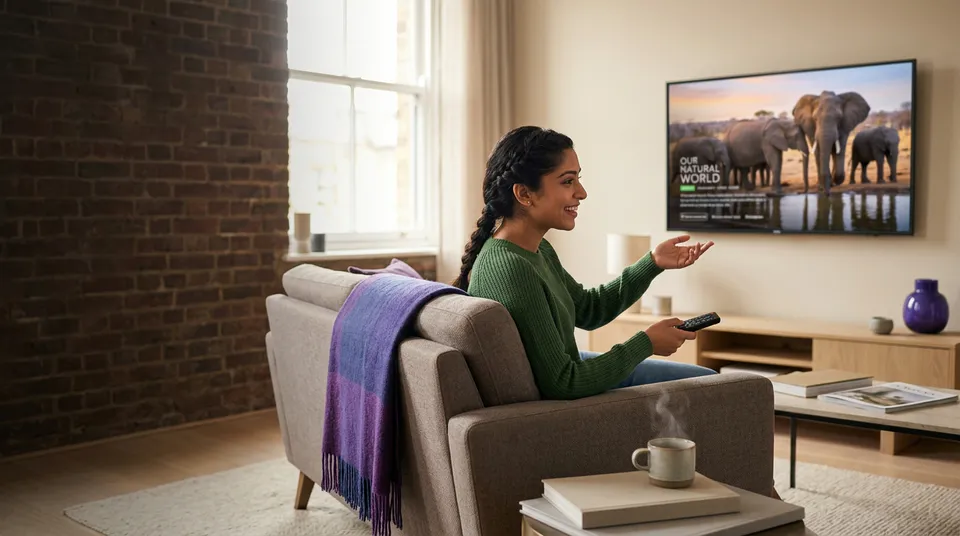

Respostas modelo, ouvidas lado a lado
Comece com a resposta mais simples, mude Band para ouvir como a mesma tarefa pode ser desenvolvida e depois registre uma resposta pessoal. Estes são exemplos didáticos, não respostas oficiais ou garantias de pontuação.
Parte 2 – Resposta do Modelo
Part 2 cue-card response
I like watching a nature documentary series on TV. It's about animals and the places they live. One episode I remember showed coral reefs and many colourful fish. I usually watch it with my flatmate or sometimes alone in the evening. We sit on the sofa and sometimes talk about what we see. I like it because the pictures are very beautiful and it is relaxing. It teaches me things but not in a difficult way. After watching I sometimes try to do small things, like use less plastic. The show is easy to follow and enjoyable.
I enjoy watching a documentary series called 'Planet Lives' on a streaming service. It explores wildlife and ecosystems around the world, with high-quality footage and interviews with scientists. The episode I like best is about coral reefs, which showed how reefs support fish and how climate change damages them. I usually watch it with my partner and sometimes with friends; we like discussing surprising facts afterwards and it sparks lively conversation. Often we make a cup of tea and pause to look things up on our phones, so it becomes a shared, relaxed experience. I like it because it combines beautiful cinematography with serious science, so it's both enjoyable and informative. The presenters explain complex ideas clearly and the pacing is calm, which helps me concentrate. Watching the series has changed how I think about conservation; for example, I started buying less single-use plastic after an episode explained its impact. The series also includes short profiles of local people trying to protect habitats, which makes the issues feel human and immediate. I appreciate the clear call-to-action at the end of each episode, like links to charities or simple lifestyle changes.
Parte 3 – Respostas do Modelo
What programs do people like to watch in your country?
People in my country watch a lot of different programmes. Popular ones are soap operas, reality TV, news and sport. Many also like comedy shows and drama series. Younger people use streaming services for international series, while older viewers often stick to TV channels. Live sport, like football, gets big audiences. Evening news is also very common.
Viewing habits are quite varied. Domestic dramas and soap operas still attract large audiences in the evenings, while reality TV and talent shows tend to draw younger viewers. Sporting events command very big live audiences, and news programmes remain important for people who want up-to-date information. At the same time, streaming platforms have shifted tastes towards international series and niche documentaries, so audiences are more fragmented now. Broadly, people choose what fits their routine and mood — some watch to unwind after work, others to keep informed or learn something new.
Do people in your country like to watch foreign TV programs?
Yes, many people enjoy foreign programmes. American and Korean series are quite popular. People watch them with subtitles or dubbed versions. Foreign shows are seen as more exciting or different. They also help people practise language a bit.
Absolutely — foreign programmes are widely watched, especially via streaming services. American, Korean and Scandinavian series have found large audiences because of distinctive storytelling and high production values. Many viewers prefer subtitles to hear the original language, which can help with language learning and cultural understanding, while others pick dubbed versions for convenience. Overall, foreign TV has broadened tastes and introduced new storytelling styles to local viewers.
What's the benefit of letting kids watch animal videos than visiting zoos?
Watching animal videos is useful because they are easy to access and safe for children. You can watch at home and pause to talk about things. They often show a wide range of animals and habitats. But they are not the same as seeing animals in real life.
Animal videos offer several practical benefits compared with zoo visits. They are readily available on tablets or phones, so children can revisit clips and learn by repetition, which helps memory. Good videos can show rare species and close-up behaviour that a local zoo might not offer, and many include scientific commentary that explains what is happening. On the other hand, films can’t fully replace the sensory experience of a real visit, but they are a useful and ethical supplement when travel, cost or animal welfare are concerns.
Do teachers play videos in class in your country?
Yes, teachers sometimes play videos in class. They use short clips for language lessons or science. Videos help explain things and keep students interested. But teachers usually add some questions or activities after the film.
Yes — teachers increasingly use video as a teaching aid. Short clips, animated explainers or segments from documentaries are handy for presenting complex ideas visually, particularly in science, history and language lessons. Many educators follow a 'teach–watch–discuss' sequence: introduce the topic, show a focused clip, then run a follow-up activity or discussion to check understanding. Used thoughtfully, video can boost engagement and cater for different learning styles, but it needs to be actively taught around to avoid passive viewing.
Do you think watching talk shows is a waste of time?
I don't think all talk shows are a waste of time. Some have useful interviews and news. Others are just for entertainment and gossip. It depends on the show and what you want.
It depends on the programme. Some talk shows offer serious interviews, expert panels and thoughtful discussion that can be informative, while others are designed for entertainment and focus on celebrity gossip or sensational stories. For viewers looking to be entertained they have their place, but if your aim is to learn something substantial it's better to choose reputable current affairs or documentary programmes. Developing a bit of critical thinking helps too — don't accept everything you hear at face value.
Do you think we can acquire knowledge from watching TV programs?
Yes, I think you can learn from TV. Documentaries, news and educational shows give facts and ideas. You can also learn practical skills from cooking or DIY programmes. But it's important to check the information sometimes.
Definitely — television can be an effective source of knowledge when programmes are well produced. Documentaries, science shows and quality news provide factual information and use visuals to explain complex topics, which often inspires viewers to read more. Even entertainment formats can teach indirectly: historical dramas might spark an interest in a period, and lifestyle programmes can teach practical skills. The key is to treat TV as a starting point and to verify facts, since not all content is accurate or free from bias.
Status da prática: Tópico arquivado de um ciclo anterior de banco de questões. Ela permanece útil para a prática de habilidades, mas não é apresentada como uma questão de exame atual ou garantida. Como os tópicos são rotulados.
Como responder Descreva um programa que você gosta de assistir Perguntas do IELTS Speaking
Para o cartão de dicas Descreva um programa que você gosta de assistir, use o minuto de preparação para construir um roteiro através da palestra. Escolha um assunto claro, adicione dois momentos ou detalhes específicos e termine explicando por que é importante. Em seguida, use as perguntas vinculadas da Parte 3 para praticar explicações e comparações mais amplas.
Solicitações do cartão de sugestão:
- O que é isso
- Do que se trata
- Com quem você assiste
- E explique por que você gosta de assistir
- Abertura: identificar a pessoa, lugar, objeto ou evento.
- Desenvolvimento: descreva dois detalhes ou momentos em uma ordem lógica.
- Extensão: explique um motivo, resultado, comparação ou problema.
- Reflexão: finalize explicando por que o assunto é memorável ou importante.
Abordagem pergunta por pergunta
| Pergunta prática | Movimento de resposta útil |
|---|---|
| What programs do people like to watch in your country? | Nomeie a coisa primeiro e depois descreva um recurso ou exemplo específico. |
| Do people in your country like to watch foreign TV programs? | Dê uma resposta direta, um motivo e um pequeno exemplo sem memorizar um roteiro. |
| What's the benefit of letting kids watch animal videos than visiting zoos? | Nomeie a coisa primeiro e depois descreva um recurso ou exemplo específico. |
| Do teachers play videos in class in your country? | Dê uma resposta direta, um motivo e um pequeno exemplo sem memorizar um roteiro. |
Foco no vocabulário
A linguagem útil já demonstrada nas respostas do modelo inclui soap opera, streaming platform, fragmented audiences, subtitles, dubbed, production values, revisit, close-up behaviour. Aprenda cada significado e uma parceria natural de palavras e, em seguida, use o item em uma nova resposta em vez de copiar um script completo.
Erros comuns a evitar
- Dar uma resposta memorizada que responde apenas parcialmente à pergunta.
- Adicionar vocabulário difícil sem verificar o significado ou a colocação.
- Reiniciar após cada erro em vez de corrigir brevemente e continuar.
- Lendo a resposta do modelo antes de gravar sua primeira tentativa.
Descreva um programa que você gosta de assistir, pratique FAQ
Como devo usar o minuto de preparação do cartão de sinalização Descreva um programa que você gosta de assistir?
Escreva palavras-chave para uma abertura, dois ou três detalhes e uma reflexão final. Não tente escrever frases completas.
Tenho que cobrir todos os marcadores do cartão de sinalização?
As instruções ajudam você a organizar a palestra. Cobri-los é útil, mas uma resposta coerente de um a dois minutos é mais importante do que marcar mecanicamente cada linha.
Como as perguntas da Parte 3 estão conectadas à Parte 2?
Desenvolvem o mesmo tema amplo através de razões, comparações, efeitos sociais ou possibilidades futuras, pelo que as respostas normalmente necessitam de mais explicações do que a Parte 1.
