
Thẻ Cue Phần 2
Hãy miêu tả một đứa trẻ mà bạn biết rất thích vẽ
Bạn nên nói:
- Làm thế nào bạn biết anh ấy/cô ấy
- Anh ấy/cô ấy là người như thế nào
- Tần suất anh ấy/cô ấy vẽ
- Và giải thích lý do tại sao bạn nghĩ anh ấy/cô ấy thích vẽ
Bạn sẽ có một đến hai phút để nói về chủ đề này.
Phần 3 Câu hỏi thảo luận
- What is the right age for a child to learn drawing?
- Why do most children draw more often than adults do?
- Why do some people visit galleries or museums instead of viewing artworks online?
- Do you think galleries and museums should be free of charge?
- How do artworks inspire people?
- What are the differences between reading a book and visiting a museum?
Trạng thái thực hành: Chủ đề được lưu trữ từ chu kỳ ngân hàng câu hỏi trước đó. Nó vẫn hữu ích cho việc thực hành kỹ năng nhưng không được trình bày dưới dạng câu hỏi thi hiện tại hoặc được đảm bảo. Cách gắn nhãn chủ đề.
Đọc bản ghi đầy đủ
I’d like to describe my nephew, Ollie, who’s seven and completely obsessed with drawing. I first noticed his skill when I babysat him last year and he produced a detailed map of our local park, complete with trees and a little duck pond, which surprised me because he’d never had formal lessons. Ollie is thoughtful and energetic with a vivid imagination; he’s surprisingly patient when he draws, often sitting for long stretches without getting distracted. He draws almost every day, usually in the evenings after school and at weekends, and sometimes he even wakes up early to finish a picture before breakfast. I think he enjoys drawing because it gives him control — he can invent whole worlds or change colours however he likes — and he’s proud when others praise his work, so it becomes a positive feedback loop; for example, when his teacher displayed one of his landscapes at school he beamed for days and kept adding new details. He usually works with pencils, felt-tip pens and watercolour, and he loves experimenting with textures and patterns. His parents encourage him by buying art books and taking him to a children’s art club, which has helped him learn new techniques and stay motivated.
Xem chủ đề trước khi nói
Sử dụng hình ảnh làm gợi ý tưởng. Mô tả những gì bạn nhận thấy, kết nối nó với trải nghiệm của bạn, sau đó trả lời câu hỏi thực sự.
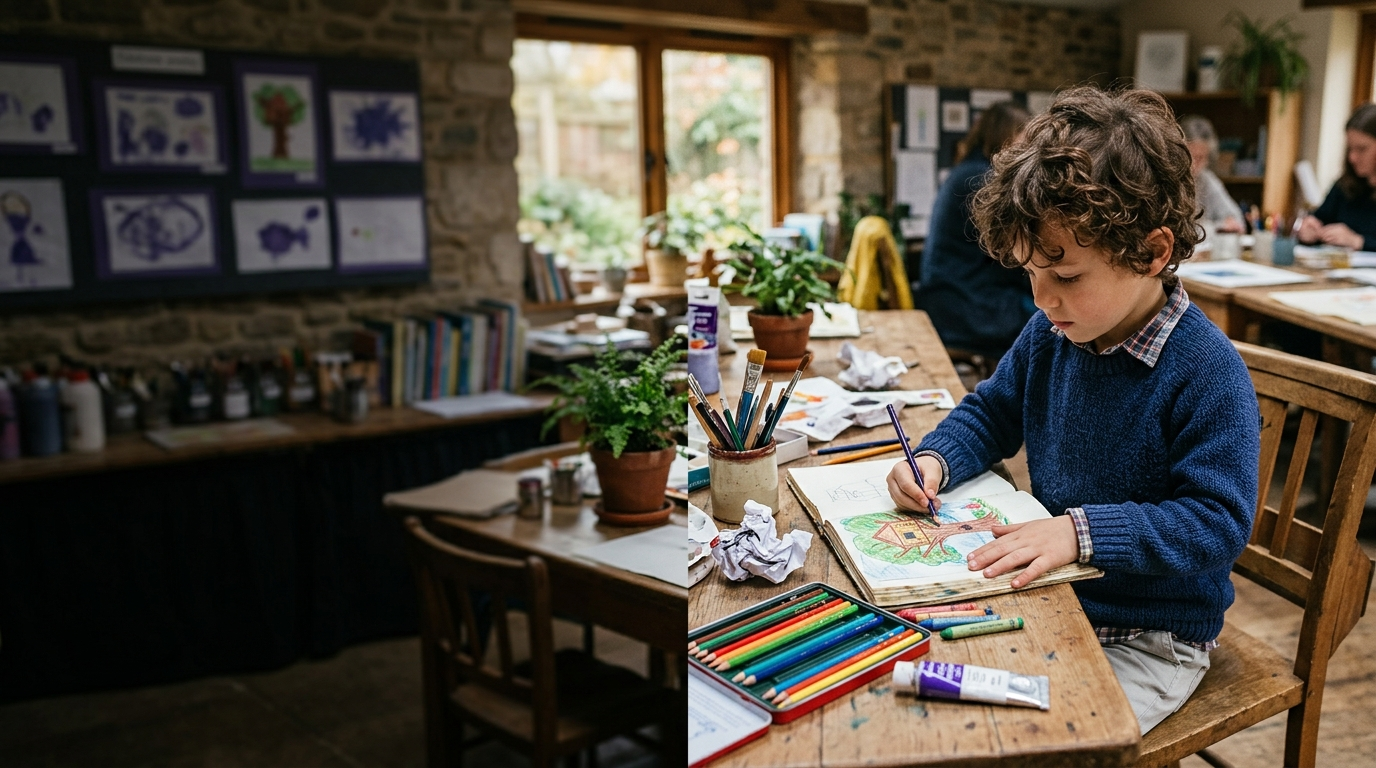

Những câu trả lời mẫu, được nghe cạnh nhau
Bắt đầu với câu trả lời đơn giản hơn, chuyển Band để nghe cách phát triển nhiệm vụ tương tự, sau đó ghi lại câu trả lời cá nhân. Đây là những ví dụ giảng dạy, không phải câu trả lời chính thức hoặc đảm bảo điểm số.
Phần 2 – Câu trả lời mẫu
Part 2 cue-card response
My cousin Mia, who is eight, loves drawing. I know her because we go to the same after-school club. She’s quite quiet and creative and likes using bright colours and drawing animals. Mia draws almost every day, usually after she finishes her homework, for about half an hour or an hour. At weekends she sometimes spends longer on a picture. I think she likes drawing because it makes her feel calm and happy, and she can show things she can’t easily say with words. Her parents keep pencils and paper handy for her so she can draw whenever she wants.
I’d like to describe my nephew, Ollie, who’s seven and completely obsessed with drawing. I first noticed his skill when I babysat him last year and he produced a detailed map of our local park, complete with trees and a little duck pond, which surprised me because he’d never had formal lessons. Ollie is thoughtful and energetic with a vivid imagination; he’s surprisingly patient when he draws, often sitting for long stretches without getting distracted. He draws almost every day, usually in the evenings after school and at weekends, and sometimes he even wakes up early to finish a picture before breakfast. I think he enjoys drawing because it gives him control — he can invent whole worlds or change colours however he likes — and he’s proud when others praise his work, so it becomes a positive feedback loop; for example, when his teacher displayed one of his landscapes at school he beamed for days and kept adding new details. He usually works with pencils, felt-tip pens and watercolour, and he loves experimenting with textures and patterns. His parents encourage him by buying art books and taking him to a children’s art club, which has helped him learn new techniques and stay motivated.
Phần 3 - Câu trả lời mẫu
What is the right age for a child to learn drawing?
I think children can start learning basic drawing as soon as they can hold a pencil, maybe around three or four. At that age they enjoy scribbling and copying simple shapes. Formal lessons aren’t necessary early on — just lots of drawing time and praise.
Around three to five is a good time to introduce drawing more deliberately because children’s fine motor skills and hand-eye coordination are developing then. That said, learning to draw isn’t a race; some kids take to it later and still become good. Early exposure through play and simple guided activities tends to help rather than strict lessons.
Why do most children draw more often than adults do?
Children draw more often because they have more free time and drawing is a natural way to play. They also like bright colours and simple stories. Adults are busier and often worry their drawings won’t be good.
Children tend to draw more because it’s a primary form of play and self-expression for them; they’re less self-conscious and have more time for unstructured activities. Adults often abandon drawing because of time pressures, concern about skill level, or simply because it’s not seen as a practical hobby. In short, freedom and low self-criticism make children draw more.
Why do some people visit galleries or museums instead of viewing artworks online?
Some people prefer galleries because you can see the real painting and its size and texture. It feels special to stand in front of a work. Online images can’t show the exact colours or surface.
Many visitors choose galleries and museums because the physical presence of an artwork — its scale, texture and colour subtleties — can’t be fully captured online. The atmosphere of a gallery and the opportunity to view works in context, perhaps with expert labels or a guided tour, also adds value. For many, seeing the original piece is an emotional experience you just can’t replicate on a screen.
Do you think galleries and museums should be free of charge?
I think some museums should be free because then more people can go, especially those who can’t afford tickets. But I also know exhibitions cost money to run, so it’s not always possible.
Ideally basic access to national museums should be free to encourage cultural participation and educational visits, especially for young people and low-income families. However, special exhibitions and conservation work require funding, so a mixed model — free core galleries with paid special shows — is often the most realistic approach. That balances accessibility with financial sustainability.
How do artworks inspire people?
Artworks can make people feel things and spark ideas. A painting might remind someone of a place or memory, or give them new ways to look at an issue. They can also motivate people to paint themselves.
Artworks inspire by provoking emotion, offering fresh perspectives, and stimulating thought; a single image can challenge assumptions or rekindle a memory. They often open up conversations about identity, history or society, and can even spur practical creativity — for instance, inspiring someone to try a new technique or start a project. Essentially, art acts as a prompt for reflection and action.
What are the differences between reading a book and visiting a museum?
Reading a book is a private, quiet activity where you imagine things, while a museum is more physical and social. In a museum you see real objects and can learn from labels or guides. Both are educational but in different ways.
Reading a book tends to be an imaginative, often solitary experience that relies on language and the reader’s inner pictures, whereas visiting a museum is multisensory and social — you see the real objects, their scale and texture, and can access curated context and interpretation. Books offer depth and personal reflection; museums provide immediacy and embodied learning. Both complement each other well, offering different pathways to understanding.
Trạng thái thực hành: Chủ đề được lưu trữ từ chu kỳ ngân hàng câu hỏi trước đó. Nó vẫn hữu ích cho việc thực hành kỹ năng nhưng không được trình bày dưới dạng câu hỏi thi hiện tại hoặc được đảm bảo. Cách gắn nhãn chủ đề.
Cách trả lời Hãy miêu tả một đứa trẻ mà bạn biết rất thích vẽ các câu hỏi IELTS Nói
Đối với phần Mô tả một đứa trẻ mà bạn biết rất thích vẽ thẻ gợi ý, hãy sử dụng phút chuẩn bị để xây dựng lộ trình xuyên suốt bài nói chuyện. Chọn một chủ đề rõ ràng, thêm hai khoảnh khắc hoặc chi tiết cụ thể và kết thúc bằng lý do tại sao nó quan trọng. Sau đó sử dụng các câu hỏi Phần 3 được liên kết để thực hành giải thích và so sánh rộng hơn.
Lời nhắc của thẻ Cue:
- Làm thế nào bạn biết anh ấy/cô ấy
- Anh ấy/cô ấy là người như thế nào
- Tần suất anh ấy/cô ấy vẽ
- Và giải thích lý do tại sao bạn nghĩ anh ấy/cô ấy thích vẽ
- Mở đầu: xác định người, địa điểm, đồ vật hoặc sự kiện.
- Phát triển: mô tả hai chi tiết hoặc khoảnh khắc theo một trình tự hợp lý.
- Phần mở rộng: giải thích lý do, kết quả, so sánh hoặc vấn đề.
- Suy ngẫm: kết thúc bằng việc tại sao chủ đề lại đáng nhớ hoặc quan trọng.
Cách tiếp cận theo từng câu hỏi
| Câu hỏi thực hành | Câu trả lời hữu ích di chuyển |
|---|---|
| What is the right age for a child to learn drawing? | Đặt tên cho sự vật trước, sau đó mô tả một tính năng hoặc ví dụ cụ thể. |
| Why do most children draw more often than adults do? | Trả lời bằng một nguyên nhân chính, sau đó hỗ trợ nó bằng một ví dụ cụ thể. |
| Why do some people visit galleries or museums instead of viewing artworks online? | Trả lời bằng một nguyên nhân chính, sau đó hỗ trợ nó bằng một ví dụ cụ thể. |
| Do you think galleries and museums should be free of charge? | Đưa ra một quan điểm có khả năng xảy ra, giải thích lý do và thêm một điều kiện hoặc ví dụ. |
Trọng tâm từ vựng
Ngôn ngữ hữu ích đã được trình bày trong các câu trả lời mẫu bao gồm fine motor skills, hand-eye coordination, exposure through play, self-expression, unstructured activities, self-conscious, physical presence, in context. Tìm hiểu từng nghĩa và cách kết hợp từ tự nhiên, sau đó sử dụng mục đó trong câu trả lời mới thay vì sao chép toàn bộ văn bản.
Những lỗi thường gặp cần tránh
- Đưa ra một câu trả lời thuộc lòng mà chỉ trả lời được một phần câu hỏi.
- Bổ sung từ vựng khó mà không cần kiểm tra nghĩa hoặc sắp xếp thứ tự.
- Khởi động lại sau mỗi lỗi thay vì sửa nhanh và tiếp tục.
- Đọc câu trả lời mẫu trước khi ghi lại lần thử đầu tiên của bạn.
Hãy miêu tả một đứa trẻ bạn biết rất thích vẽ và luyện tập Câu hỏi thường gặp
Tôi nên sử dụng phút chuẩn bị thẻ gợi ý mô tả một đứa trẻ mà bạn biết rất thích vẽ như thế nào?
Viết từ khóa cho phần mở đầu, hai hoặc ba chi tiết và suy ngẫm cuối cùng. Đừng cố gắng viết câu hoàn chỉnh.
Tôi có phải che từng viên đạn của thẻ gợi ý không?
Những lời nhắc giúp bạn tổ chức cuộc nói chuyện. Bao gồm chúng là hữu ích, nhưng một phản hồi mạch lạc từ một đến hai phút quan trọng hơn việc đánh dấu từng dòng một cách máy móc.
Các câu hỏi của Phần 3 được kết nối với Phần 2 như thế nào?
Chúng phát triển cùng một chủ đề rộng thông qua các lý do, so sánh, hiệu ứng xã hội hoặc khả năng trong tương lai, vì vậy các câu trả lời thường cần được giải thích nhiều hơn Phần 1.
