
Tarjeta de referencia de la parte 2
Describe a un niño que conoces al que le gusta mucho dibujar.
Deberías decir:
- Cómo lo conociste
- Como es el/ella
- ¿Con qué frecuencia dibuja?
- Y explica por qué crees que le gusta dibujar.
Tendrás uno o dos minutos para hablar sobre este tema.
Parte 3 Preguntas de discusión
- What is the right age for a child to learn drawing?
- Why do most children draw more often than adults do?
- Why do some people visit galleries or museums instead of viewing artworks online?
- Do you think galleries and museums should be free of charge?
- How do artworks inspire people?
- What are the differences between reading a book and visiting a museum?
Estado de la práctica: tema archivado de un ciclo anterior del banco de preguntas. Sigue siendo útil para la práctica de habilidades, pero no se presenta como una pregunta de examen actual o garantizada. Cómo se etiquetan los temas.
Lea la transcripción completa
I’d like to describe my nephew, Ollie, who’s seven and completely obsessed with drawing. I first noticed his skill when I babysat him last year and he produced a detailed map of our local park, complete with trees and a little duck pond, which surprised me because he’d never had formal lessons. Ollie is thoughtful and energetic with a vivid imagination; he’s surprisingly patient when he draws, often sitting for long stretches without getting distracted. He draws almost every day, usually in the evenings after school and at weekends, and sometimes he even wakes up early to finish a picture before breakfast. I think he enjoys drawing because it gives him control — he can invent whole worlds or change colours however he likes — and he’s proud when others praise his work, so it becomes a positive feedback loop; for example, when his teacher displayed one of his landscapes at school he beamed for days and kept adding new details. He usually works with pencils, felt-tip pens and watercolour, and he loves experimenting with textures and patterns. His parents encourage him by buying art books and taking him to a children’s art club, which has helped him learn new techniques and stay motivated.
Vea el tema antes de hablar.
Utilice las imágenes como sugerencias de ideas. Describe lo que notas, conéctalo con tu experiencia y luego responde la pregunta real.
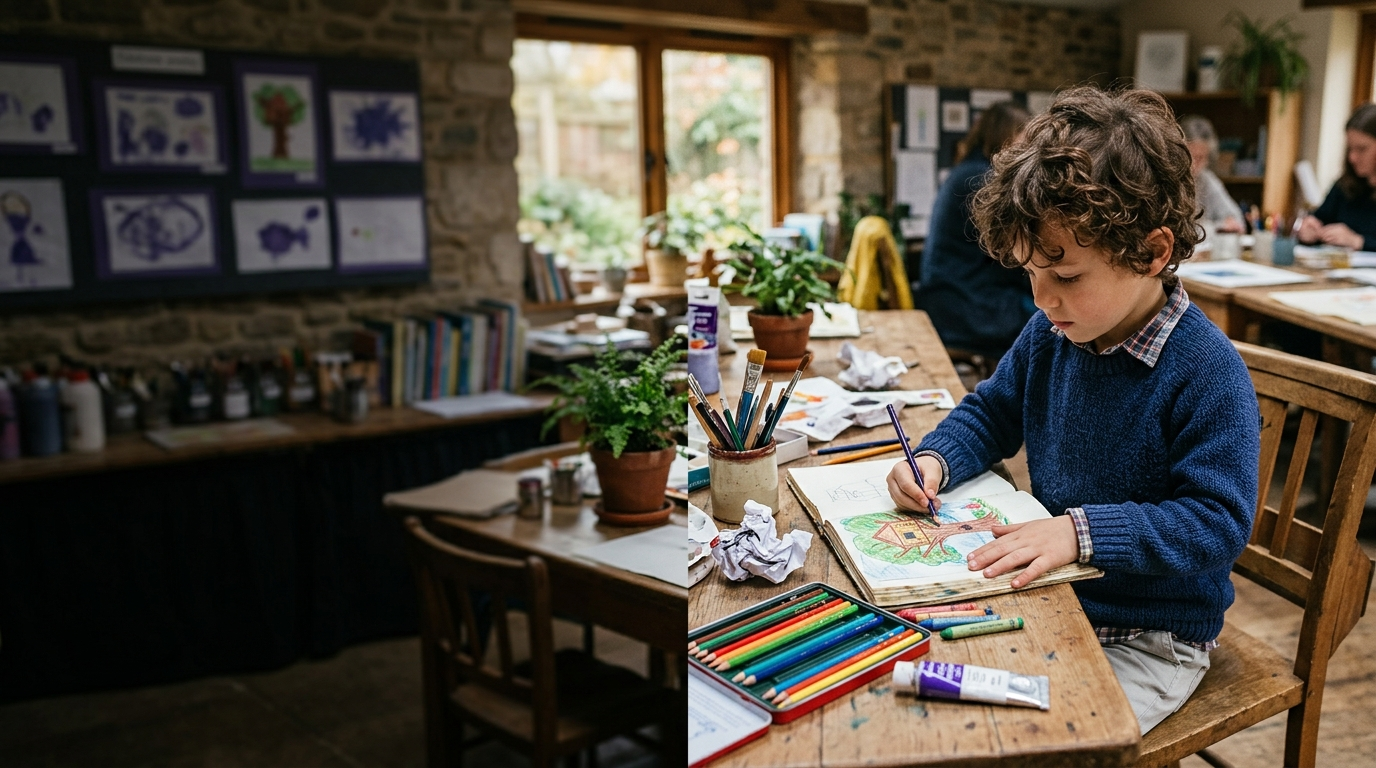
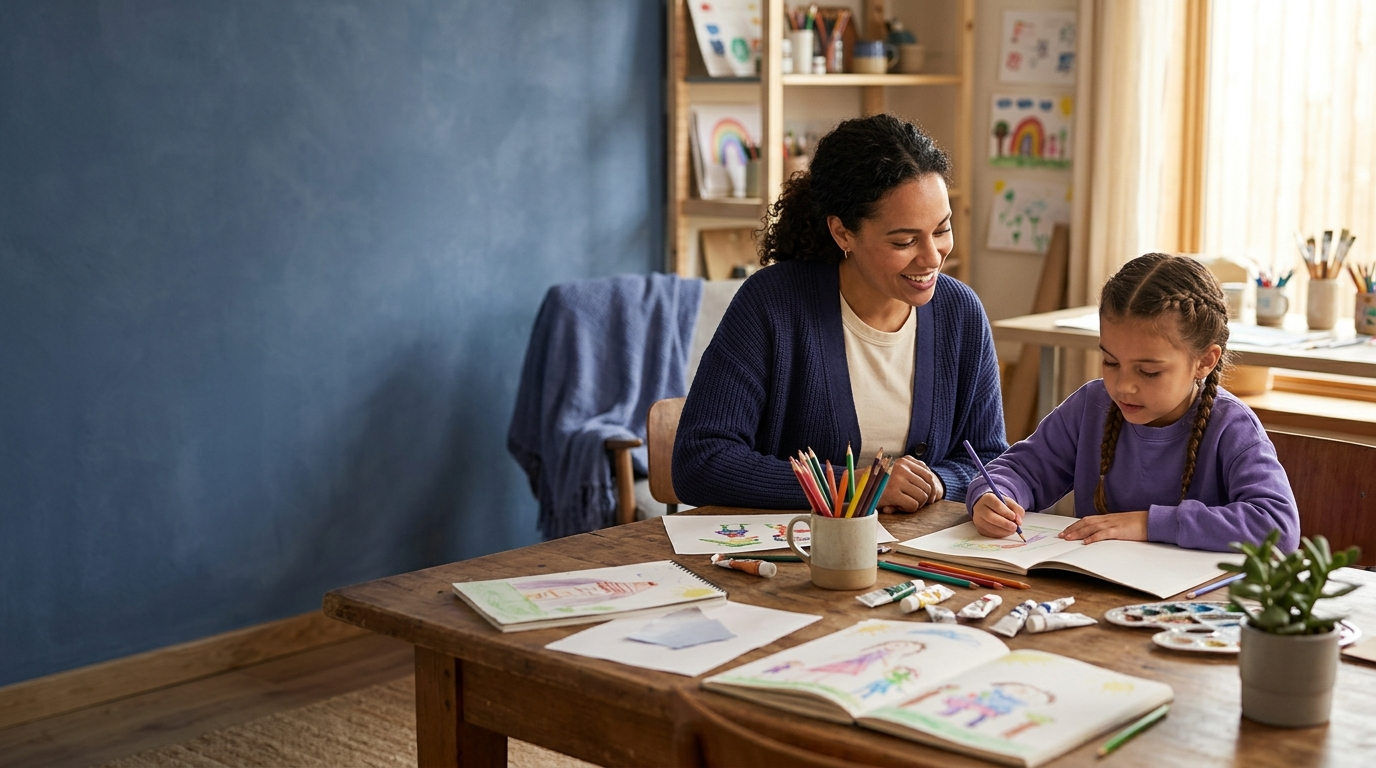
Respuestas modelo, escuchadas una al lado de la otra
Comience con la respuesta más simple, cambie Band para escuchar cómo se puede desarrollar la misma tarea y luego registre una respuesta personal. Estos son ejemplos de enseñanza, no respuestas oficiales ni garantías de puntuación.
Parte 2: Respuesta modelo
Part 2 cue-card response
My cousin Mia, who is eight, loves drawing. I know her because we go to the same after-school club. She’s quite quiet and creative and likes using bright colours and drawing animals. Mia draws almost every day, usually after she finishes her homework, for about half an hour or an hour. At weekends she sometimes spends longer on a picture. I think she likes drawing because it makes her feel calm and happy, and she can show things she can’t easily say with words. Her parents keep pencils and paper handy for her so she can draw whenever she wants.
I’d like to describe my nephew, Ollie, who’s seven and completely obsessed with drawing. I first noticed his skill when I babysat him last year and he produced a detailed map of our local park, complete with trees and a little duck pond, which surprised me because he’d never had formal lessons. Ollie is thoughtful and energetic with a vivid imagination; he’s surprisingly patient when he draws, often sitting for long stretches without getting distracted. He draws almost every day, usually in the evenings after school and at weekends, and sometimes he even wakes up early to finish a picture before breakfast. I think he enjoys drawing because it gives him control — he can invent whole worlds or change colours however he likes — and he’s proud when others praise his work, so it becomes a positive feedback loop; for example, when his teacher displayed one of his landscapes at school he beamed for days and kept adding new details. He usually works with pencils, felt-tip pens and watercolour, and he loves experimenting with textures and patterns. His parents encourage him by buying art books and taking him to a children’s art club, which has helped him learn new techniques and stay motivated.
Parte 3: Respuestas modelo
What is the right age for a child to learn drawing?
I think children can start learning basic drawing as soon as they can hold a pencil, maybe around three or four. At that age they enjoy scribbling and copying simple shapes. Formal lessons aren’t necessary early on — just lots of drawing time and praise.
Around three to five is a good time to introduce drawing more deliberately because children’s fine motor skills and hand-eye coordination are developing then. That said, learning to draw isn’t a race; some kids take to it later and still become good. Early exposure through play and simple guided activities tends to help rather than strict lessons.
Why do most children draw more often than adults do?
Children draw more often because they have more free time and drawing is a natural way to play. They also like bright colours and simple stories. Adults are busier and often worry their drawings won’t be good.
Children tend to draw more because it’s a primary form of play and self-expression for them; they’re less self-conscious and have more time for unstructured activities. Adults often abandon drawing because of time pressures, concern about skill level, or simply because it’s not seen as a practical hobby. In short, freedom and low self-criticism make children draw more.
Why do some people visit galleries or museums instead of viewing artworks online?
Some people prefer galleries because you can see the real painting and its size and texture. It feels special to stand in front of a work. Online images can’t show the exact colours or surface.
Many visitors choose galleries and museums because the physical presence of an artwork — its scale, texture and colour subtleties — can’t be fully captured online. The atmosphere of a gallery and the opportunity to view works in context, perhaps with expert labels or a guided tour, also adds value. For many, seeing the original piece is an emotional experience you just can’t replicate on a screen.
Do you think galleries and museums should be free of charge?
I think some museums should be free because then more people can go, especially those who can’t afford tickets. But I also know exhibitions cost money to run, so it’s not always possible.
Ideally basic access to national museums should be free to encourage cultural participation and educational visits, especially for young people and low-income families. However, special exhibitions and conservation work require funding, so a mixed model — free core galleries with paid special shows — is often the most realistic approach. That balances accessibility with financial sustainability.
How do artworks inspire people?
Artworks can make people feel things and spark ideas. A painting might remind someone of a place or memory, or give them new ways to look at an issue. They can also motivate people to paint themselves.
Artworks inspire by provoking emotion, offering fresh perspectives, and stimulating thought; a single image can challenge assumptions or rekindle a memory. They often open up conversations about identity, history or society, and can even spur practical creativity — for instance, inspiring someone to try a new technique or start a project. Essentially, art acts as a prompt for reflection and action.
What are the differences between reading a book and visiting a museum?
Reading a book is a private, quiet activity where you imagine things, while a museum is more physical and social. In a museum you see real objects and can learn from labels or guides. Both are educational but in different ways.
Reading a book tends to be an imaginative, often solitary experience that relies on language and the reader’s inner pictures, whereas visiting a museum is multisensory and social — you see the real objects, their scale and texture, and can access curated context and interpretation. Books offer depth and personal reflection; museums provide immediacy and embodied learning. Both complement each other well, offering different pathways to understanding.
Estado de la práctica: tema archivado de un ciclo anterior del banco de preguntas. Sigue siendo útil para la práctica de habilidades, pero no se presenta como una pregunta de examen actual o garantizada. Cómo se etiquetan los temas.
Cómo responder Describe a un niño que conoces y al que le gusta mucho dibujar las preguntas orales del IELTS.
Para la tarjeta Describe a un niño que conoces a quien le gusta mucho dibujar, utiliza el minuto de preparación para construir una ruta a lo largo de la charla. Elija un tema claro, agregue dos momentos o detalles específicos y termine explicando por qué es importante. Luego utilice las preguntas vinculadas de la Parte 3 para practicar explicaciones y comparaciones más amplias.
Indicaciones de la tarjeta de referencia:
- Cómo lo conociste
- Como es el/ella
- ¿Con qué frecuencia dibuja?
- Y explica por qué crees que le gusta dibujar.
- Apertura: identificar a la persona, lugar, objeto o evento.
- Desarrollo: describir dos detalles o momentos en un orden lógico.
- Ampliación: explicar un motivo, resultado, comparación o problema.
- Reflexión: terminar con por qué el tema es memorable o importante.
Enfoque pregunta por pregunta
| pregunta de práctica | movimiento de respuesta útil |
|---|---|
| What is the right age for a child to learn drawing? | Primero nombra el objeto y luego describe una característica o ejemplo específico. |
| Why do most children draw more often than adults do? | Responda con una causa principal y luego apóyela con un ejemplo concreto. |
| Why do some people visit galleries or museums instead of viewing artworks online? | Responda con una causa principal y luego apóyela con un ejemplo concreto. |
| Do you think galleries and museums should be free of charge? | Indique una opinión probable, explique el motivo y agregue una condición o ejemplo. |
Enfoque de vocabulario
El lenguaje útil ya demostrado en las respuestas modelo incluye fine motor skills, hand-eye coordination, exposure through play, self-expression, unstructured activities, self-conscious, physical presence, in context. Aprenda cada significado y una asociación natural de palabras, luego use el elemento en una respuesta nueva en lugar de copiar un guión completo.
Errores comunes a evitar
- Dar una respuesta memorizada que responda sólo parcialmente a la pregunta.
- Agregar vocabulario difícil sin verificar el significado o la colocación.
- Reiniciar después de cada error en lugar de corregir brevemente y continuar.
- Leer la respuesta modelo antes de grabar su primer intento.
Describe a un niño que conoces al que le gusta mucho dibujar. Preguntas frecuentes sobre práctica.
¿Cómo debo utilizar el minuto de preparación de las tarjetas de referencia Describe a un niño que conoces y al que le gusta mucho dibujar?
Escribe palabras clave para una apertura, dos o tres detalles y una reflexión final. No intentes escribir oraciones completas.
¿Tengo que cubrir cada viñeta de la tarjeta de referencia?
Las indicaciones le ayudarán a organizar la charla. Cubrirlos es útil, pero una respuesta coherente de uno a dos minutos es más importante que marcar mecánicamente cada línea.
¿Cómo se conectan las preguntas de la Parte 3 con la Parte 2?
Desarrollan el mismo tema amplio a través de razones, comparaciones, efectos sociales o posibilidades futuras, por lo que las respuestas normalmente necesitan más explicaciones que la Parte 1.
