
IELTS Speaking Part 1: Sports team Questions and Answers

Part 1 questions
Move one question at a time: listen, answer, compare and retry. The complete question text remains in the page HTML for accessibility and search.
- 01Have you ever been part of a sports team?
- 02Are team sports popular in your culture?
- 03Do you like watching team games? Why?
- 04What are the differences between team sports and individual sports?
Read the complete transcript
Yes — I played for my school football side and later joined a local community team for a couple of years. I usually played at full‑back, so I learned a lot about communication and positioning. It was good for fitness and I liked the camaraderie and shared responsibility that comes with being in a squad.
Preparation status: Dated predicted practice collection. This independent practice resource is not an official IELTS paper, and the questions in your test can be different. How topics are labelled.
See the topic before you speak
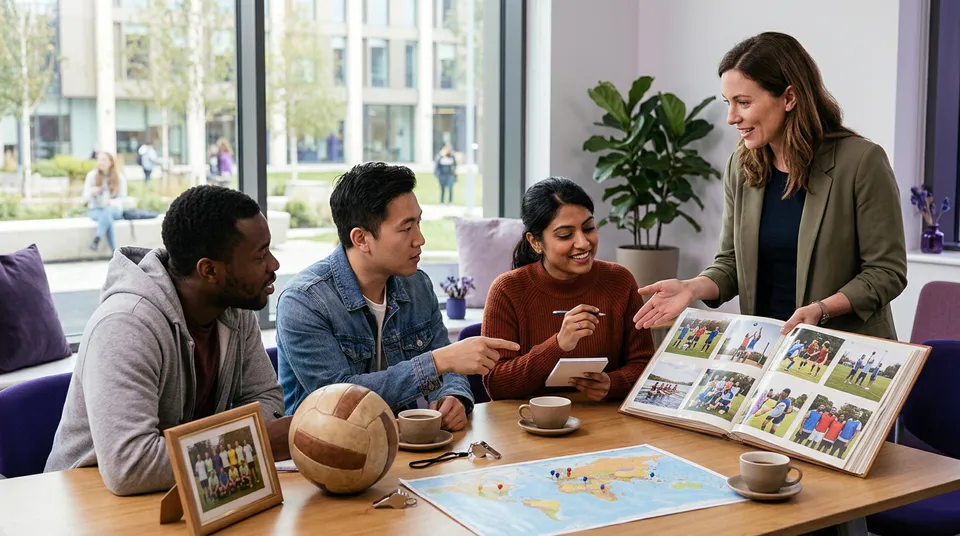
Use the images as idea prompts. Describe what you notice, connect it to your experience, then answer the real question.

Model answers, heard side by side
Start with the simpler answer, switch bands to hear how the same task can be developed, then record a personal response. These are teaching examples, not official answers or score guarantees.
Have you ever been part of a sports team?
Yes, I have. I used to play in my school football team when I was a teenager. We trained twice a week and played local matches. I enjoyed it because I liked running and being with friends.
Yes — I played for my school football side and later joined a local community team for a couple of years. I usually played at full‑back, so I learned a lot about communication and positioning. It was good for fitness and I liked the camaraderie and shared responsibility that comes with being in a squad.
Are team sports popular in your culture?
Yes, team sports are quite popular. Sports like football and netball are common and many children join clubs. People also watch matches on TV and go to local games.
Yes, team sports are very popular. Football and rugby tend to dominate, but you also see strong participation in community-level netball and basketball. Schools and clubs encourage youngsters to play, and the team format suits people who enjoy social interaction as much as competition.
Do you like watching team games? Why?
I do like watching team games, especially football. The matches are exciting and the crowd makes it fun. I watch with friends and we cheer for our team.
Yes, I enjoy watching team sports, particularly live matches. I find the tactics and how players combine far more interesting than solo events. Also, the atmosphere in a stadium and the chance to watch friends or local teams makes it more engaging.
What are the differences between team sports and individual sports?
Team sports need players to work together and share the win or loss. Individual sports depend on one person's skill and they feel more pressure. Training is similar but the focus is different.
Team sports rely on co‑ordination, role specialisation and communication — success often comes from how well people combine. Individual sports place the spotlight on personal technique and mental resilience, so the pressure is concentrated on one athlete. The preparation and psychology can be very different as a result.
Practice status: Archived topic from a previous question-bank cycle. It remains useful for skill practice but is not presented as a current or guaranteed exam question. How topics are labelled.
How to answer Sports team IELTS Speaking questions
This Sports team set contains 4 short interview questions. Start each answer with the information the examiner asked for, then extend it with one reason, example or contrast. The goal is spontaneous, connected speech—not a mini-essay.
- Answer the exact question in the first sentence.
- Add one reason or specific personal detail.
- Use an example or contrast only when it adds new information.
- Finish naturally and let the examiner ask the next question.
Question-by-question approach
| Practice question | Useful answer move |
|---|---|
| Have you ever been part of a sports team? | Give a real past example, then say what changed or why it mattered. |
| Are team sports popular in your culture? | Give a direct answer, one reason and a short example without memorising a script. |
| Do you like watching team games? Why? | Answer directly, give a reason and add one natural personal detail. |
| What are the differences between team sports and individual sports? | Name the thing first, then describe a specific feature or example. |
Vocabulary focus
Useful language already demonstrated in the model answers includes to be part of, camaraderie, shared responsibility, dominate, community-level, social interaction, tactics, atmosphere. Learn each meaning and a natural word partnership, then use the item in a fresh answer instead of copying a complete script.
Common mistakes to avoid
- Giving a memorised response that only partly answers the question.
- Adding difficult vocabulary without checking meaning or collocation.
- Restarting after every error instead of correcting briefly and continuing.
- Reading the model answer before recording your own first attempt.
Sports team practice FAQ
How long should my answer be for Sports team in Part 1?
Aim for a direct answer plus a reason or detail, usually two to four sentences. Stop when the idea is complete rather than forcing a fixed word count.
Should I memorise the Sports team model answers?
No. Use them to notice structure and language, then answer from your own experience. Memorised wording can fail when the examiner changes the question.
What if I have no experience of the topic?
Say that honestly, then explain a related preference, observation or hypothetical example. You are assessed on language, not specialist knowledge.