
IELTS Speaking Part 1: Music Questions and Answers

Part 1 questions
Move one question at a time: listen, answer, compare and retry. The complete question text remains in the page HTML for accessibility and search.
- 01Do you prefer sad or happy music?
- 02Does happy music make you feel more excited?
- 03Have you taken any music classes?
- 04Do you listen to music while doing other things?
Read the complete transcript
I tend to favour happy, upbeat music because it lifts my spirits and helps me get into a positive mood. That said, I do have a soft spot for melancholic songs too — they can be quite cathartic and give you space to reflect. So it really depends on my mood and the situation.
Preparation status: Dated predicted practice collection. This independent practice resource is not an official IELTS paper, and the questions in your test can be different. How topics are labelled.
See the topic before you speak
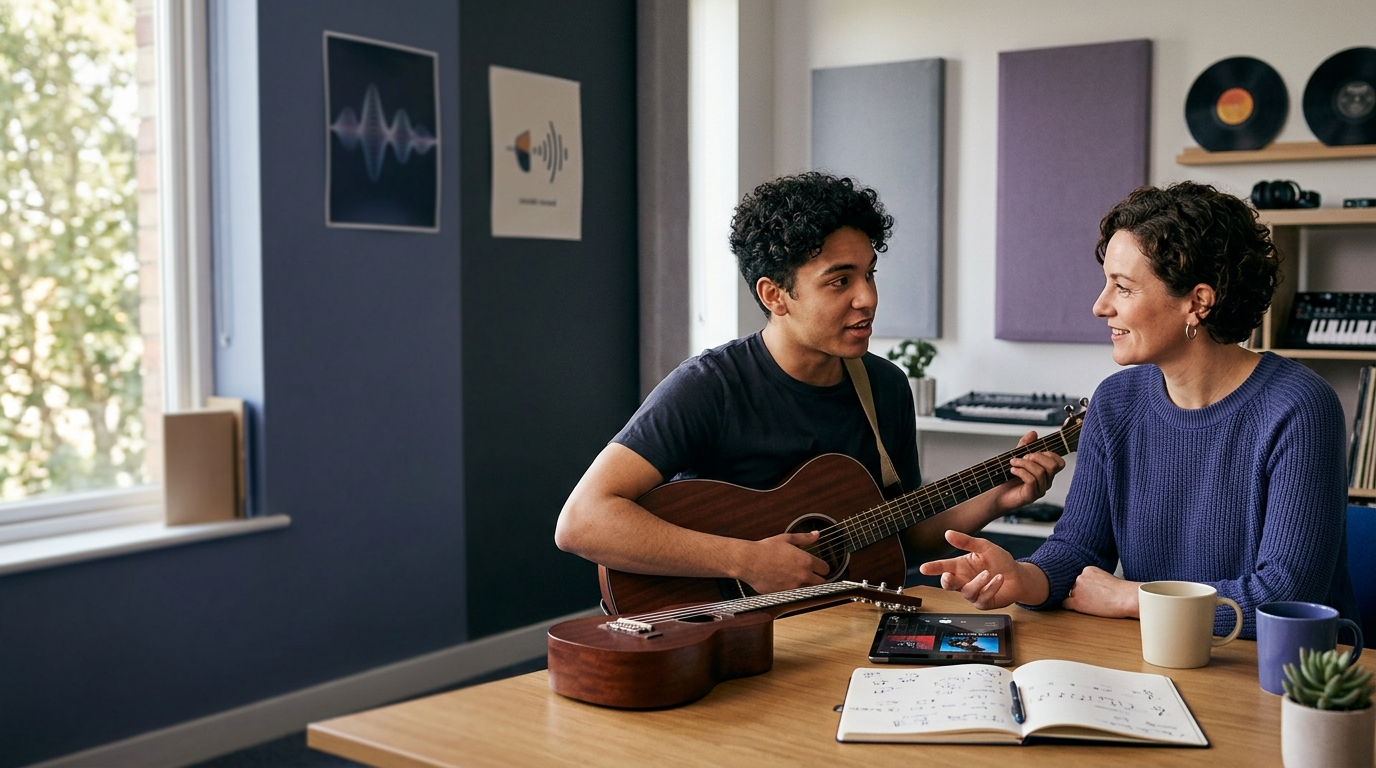
Use the images as idea prompts. Describe what you notice, connect it to your experience, then answer the real question.

Model answers, heard side by side
Start with the simpler answer, switch bands to hear how the same task can be developed, then record a personal response. These are teaching examples, not official answers or score guarantees.
Do you prefer sad or happy music?
I usually prefer happy music. It makes me feel more energetic and I enjoy singing along. But sometimes I like sad songs when I'm tired or thinking about something. Sad music can be relaxing and helps me feel better.
I tend to favour happy, upbeat music because it lifts my spirits and helps me get into a positive mood. That said, I do have a soft spot for melancholic songs too — they can be quite cathartic and give you space to reflect. So it really depends on my mood and the situation.
Does happy music make you feel more excited?
Yes, happy music often makes me feel more excited. Fast songs with a strong beat make me want to move or dance. But calm happy songs don't make me excited, they just make me feel pleasant.
On the whole, happy music does tend to make me feel more energised, especially if it has an uptempo beat and a driving rhythm — that really gets me going. However, context matters: if I'm tired or trying to concentrate, even upbeat tunes won't necessarily make me excited. Familiarity with a song also affects how strongly I react.
Have you taken any music classes?
Yes, I had piano lessons when I was a child. I did them for a few years and learnt some simple pieces. I stopped when I was a teenager because I was busy with school. I still practise sometimes for fun.
Yes — I had piano lessons from about seven and carried on for several years. They were one-to-one lessons, so I picked up technique, how to read notation and a few classical pieces. Later I joined a small ensemble at school, which really helped my timing and listening skills. Those experiences definitely increased my appreciation of music.
Do you listen to music while doing other things?
Yes, I often listen to music while doing other things. I play music when I cook, clean or travel. Sometimes I listen while studying, but only quiet songs because I need to concentrate.
Yes, I quite often have music on as background while I'm doing things. For exercise or housework I prefer lively tracks, but when I'm studying I switch to instrumental or ambient pieces so the lyrics don't distract me. Music helps set a rhythm, though if it's too engaging it can actually reduce my concentration.
Practice status: Archived topic from a previous question-bank cycle. It remains useful for skill practice but is not presented as a current or guaranteed exam question. How topics are labelled.
How to answer Music IELTS Speaking questions
This Music set contains 4 short interview questions. Start each answer with the information the examiner asked for, then extend it with one reason, example or contrast. The goal is spontaneous, connected speech—not a mini-essay.
- Answer the exact question in the first sentence.
- Add one reason or specific personal detail.
- Use an example or contrast only when it adds new information.
- Finish naturally and let the examiner ask the next question.
Question-by-question approach
| Practice question | Useful answer move |
|---|---|
| Do you prefer sad or happy music? | Answer directly, give a reason and add one natural personal detail. |
| Does happy music make you feel more excited? | Give a direct answer, one reason and a short example without memorising a script. |
| Have you taken any music classes? | Give a real past example, then say what changed or why it mattered. |
| Do you listen to music while doing other things? | Answer directly, give a reason and add one natural personal detail. |
Vocabulary focus
Useful language already demonstrated in the model answers includes lift my spirits, soft spot, melancholic, get me going, uptempo, pump me up, one-to-one lessons, practise scales. Learn each meaning and a natural word partnership, then use the item in a fresh answer instead of copying a complete script.
Common mistakes to avoid
- Giving a memorised response that only partly answers the question.
- Adding difficult vocabulary without checking meaning or collocation.
- Restarting after every error instead of correcting briefly and continuing.
- Reading the model answer before recording your own first attempt.
Music practice FAQ
How long should my answer be for Music in Part 1?
Aim for a direct answer plus a reason or detail, usually two to four sentences. Stop when the idea is complete rather than forcing a fixed word count.
Should I memorise the Music model answers?
No. Use them to notice structure and language, then answer from your own experience. Memorised wording can fail when the examiner changes the question.
What if I have no experience of the topic?
Say that honestly, then explain a related preference, observation or hypothetical example. You are assessed on language, not specialist knowledge.