
IELTS Speaking Part 1: Outer space and stars Questions and Answers

Part 1 questions
Move one question at a time: listen, answer, compare and retry. The complete question text remains in the page HTML for accessibility and search.
- 01Have you ever learnt about outer space and stars?Full Band 6/7 answer →
- 02Do you like science fiction movies? Why?
- 03Do you want to know more about outer space?
- 04Do you want to go into outer space in the future?
Read the complete transcript
Yes, I have. At school we did a few units on astronomy and I also visited a planetarium once, which made it more vivid. Since then I've watched documentaries and followed a few online talks about topics like light‑years, exoplanets and how stars form. I guess I’ve picked up a mix of formal facts and popular explanations, so I can understand simple astronomy and also enjoy more detailed discussions when they come up.
Preparation status: Predicted topic cycle. This independent practice resource is not an official IELTS paper, and the questions in your test can be different. How topics are labelled.
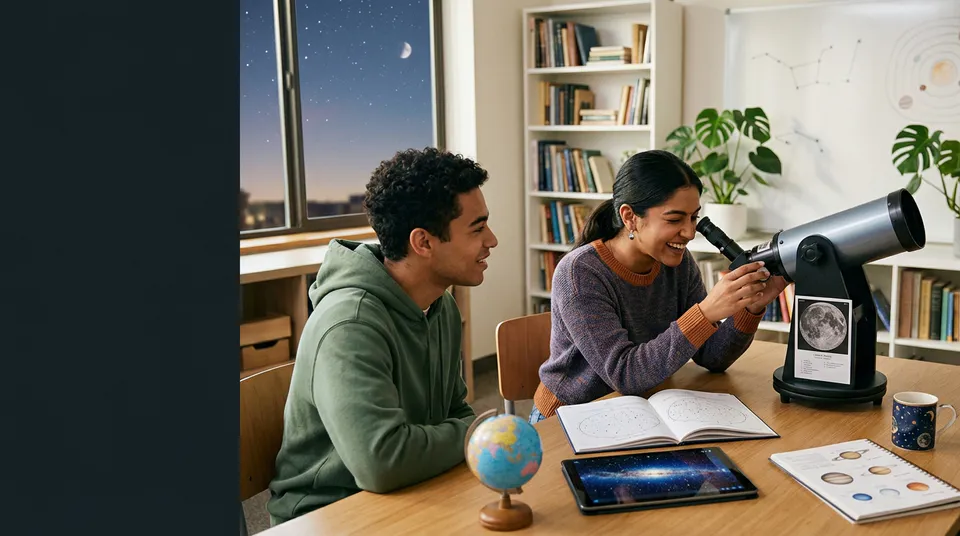
See the topic before you speak
Use the images as idea prompts. Describe what you notice, connect it to your experience, then answer the real question.

Model answers, heard side by side
Start with the simpler answer, switch bands to hear how the same task can be developed, then record a personal response. These are teaching examples, not official answers or score guarantees.
Have you ever learnt about outer space and stars?
Yes, I have. I first learnt about outer space and stars at school in science lessons. We talked about the Sun, the planets and simple ideas like gravity. Later I watched a few documentaries and read articles online about constellations and the odd comet. It was interesting but mostly basic facts.
Yes, I have. At school we did a few units on astronomy and I also visited a planetarium once, which made it more vivid. Since then I've watched documentaries and followed a few online talks about topics like light‑years, exoplanets and how stars form. I guess I’ve picked up a mix of formal facts and popular explanations, so I can understand simple astronomy and also enjoy more detailed discussions when they come up.
Do you like science fiction movies? Why?
I do like science fiction movies. They’re fun and often exciting, with good special effects. I enjoy the escape and the ideas about space travel, even if some parts are unrealistic. Sometimes they’re a bit predictable, but I still watch them.
Yes, I’m a fan of good science fiction. I like films that combine believable science with strong characters because they make you think about the future and what it means to be human. For example, films that explore ethical dilemmas around artificial intelligence or space exploration really grab me, not just the spectacular special effects. Even when a film takes liberties with the science, as long as it keeps the story believable I’ll happily suspend my disbelief.
Do you want to know more about outer space?
Yes, I’d like to know more. Space seems mysterious and there are lots of things I don’t understand, like black holes and other planets. I often read a short article or watch a video when I have time.
Definitely. I’m curious not only about the big questions, like how the universe began, but also about practical advances such as satellite technology and the search for exoplanets. I follow a few science channels and occasionally take online lectures, because learning more helps me appreciate how discoveries can affect life on Earth. In short, there’s a lot I don’t know and I’d like to keep learning.
Do you want to go into outer space in the future?
Maybe, but I’m not sure. It sounds exciting to go into space, but it also seems dangerous and expensive. I’d probably prefer to try a short tourist flight rather than stay up there for long.
I’d love the idea of going into space one day, but only if it became reasonably safe and affordable. The idea of seeing Earth from orbit is incredibly appealing, yet I’m mindful of the health risks of microgravity and the intensive training involved. If commercial space tourism becomes routine and the safety record improves, I’d seriously consider a short trip, but long missions? I think I’d leave those to professional astronauts.
How to answer Outer space and stars IELTS Speaking questions
This Outer space and stars set contains 4 short interview questions. Start each answer with the information the examiner asked for, then extend it with one reason, example or contrast. The goal is spontaneous, connected speech—not a mini-essay.
- Answer the exact question in the first sentence.
- Add one reason or specific personal detail.
- Use an example or contrast only when it adds new information.
- Finish naturally and let the examiner ask the next question.
Question-by-question approach
| Practice question | Useful answer move |
|---|---|
| Have you ever learnt about outer space and stars? | Give a real past example, then say what changed or why it mattered. |
| Do you like science fiction movies? Why? | Answer directly, give a reason and add one natural personal detail. |
| Do you want to know more about outer space? | Answer directly, give a reason and add one natural personal detail. |
| Do you want to go into outer space in the future? | Answer directly, give a reason and add one natural personal detail. |
Vocabulary focus
Useful language already demonstrated in the model answers includes constellation, planetarium, light‑year, sci‑fi, special effects, suspension of disbelief, exoplanet, dark matter. Learn each meaning and a natural word partnership, then use the item in a fresh answer instead of copying a complete script.
Common mistakes to avoid
- Giving a memorised response that only partly answers the question.
- Adding difficult vocabulary without checking meaning or collocation.
- Restarting after every error instead of correcting briefly and continuing.
- Reading the model answer before recording your own first attempt.
Outer space and stars practice FAQ
How long should my answer be for Outer space and stars in Part 1?
Aim for a direct answer plus a reason or detail, usually two to four sentences. Stop when the idea is complete rather than forcing a fixed word count.
Should I memorise the Outer space and stars model answers?
No. Use them to notice structure and language, then answer from your own experience. Memorised wording can fail when the examiner changes the question.
What if I have no experience of the topic?
Say that honestly, then explain a related preference, observation or hypothetical example. You are assessed on language, not specialist knowledge.
