
Part 1 Questions
- Did you do some house cleaning when you were young?
- What housework do you like or dislike doing?
- Do you like cooking?
- How often do you cook?
- Do you enjoy cooking with others?
- Do you like to cook for a large group of people?
- What do you think of working as a waiter?
Practice status: Archived topic from a previous question-bank cycle. It remains useful for skill practice but is not presented as a current or guaranteed exam question. How topics are labelled.
Read the complete transcript
Yes, from about eight years old I had a small rota. I’d clear the table, wash up and sometimes hoover the living room; at weekends I helped my mum with a deeper clean. It taught me responsibility and how to divide jobs so the house didn’t feel overwhelming.
See the topic before you speak
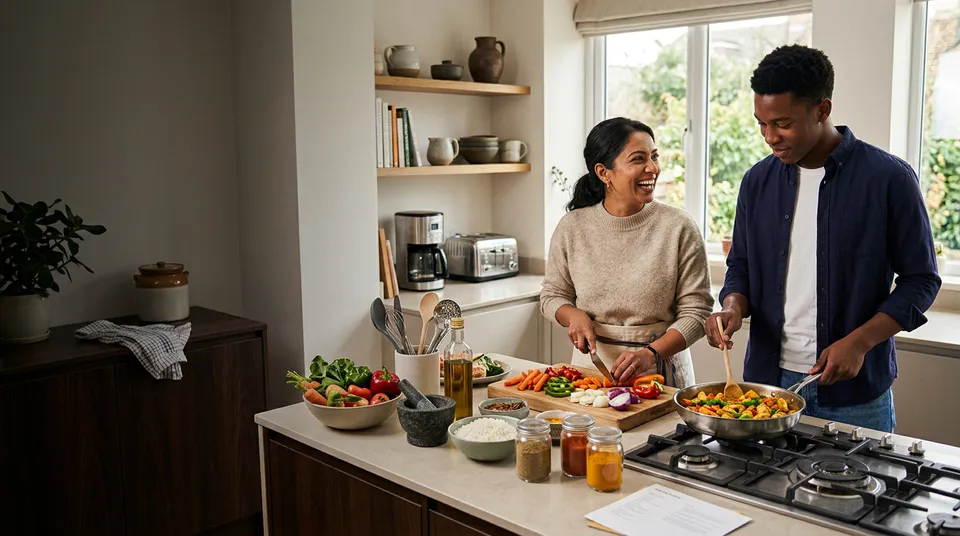
Use the images as idea prompts. Describe what you notice, connect it to your experience, then answer the real question.

Model answers, heard side by side
Start with the simpler answer, switch bands to hear how the same task can be developed, then record a personal response. These are teaching examples, not official answers or score guarantees.
Did you do some house cleaning when you were young?
Yes. When I was young I helped at home a lot. I used to sweep the floor, dust the shelves and clear the table after meals. My parents asked me to do these things every weekend, so it became a habit.
Yes, from about eight years old I had a small rota. I’d clear the table, wash up and sometimes hoover the living room; at weekends I helped my mum with a deeper clean. It taught me responsibility and how to divide jobs so the house didn’t feel overwhelming.
What housework do you like or dislike doing?
I don’t mind cooking and I like washing the dishes because it’s easy. I really dislike ironing though; it’s boring and takes too long.
I enjoy cooking and organising the kitchen because it feels productive, but I really dislike ironing — it’s tedious and you don’t see quick results. I prefer tasks where you can see a clear, immediate finish, like vacuuming or wiping surfaces.
Do you like cooking?
Yes, I like cooking most of the time. I enjoy making simple meals like pasta or stir-fries. It’s relaxing and I like eating what I’ve made.
Yes, I do — cooking is a creative outlet for me. I like trying new recipes and mixing flavours, and I find preparing food quite therapeutic after a busy day.
How often do you cook?
I cook about three or four times a week, usually in the evenings. On busy days I buy ready meals or eat out.
I cook most evenings — probably five nights a week. I batch-cook at the weekend so I’ve got meals ready during the week, which saves time and helps me eat more healthily.
Do you enjoy cooking with others?
Sometimes I do. Cooking with family can be fun because you talk while you cook, but it can also be a bit crowded in the kitchen.
Yes, I enjoy it — cooking with others is social and often more efficient. You can split tasks, swap tips and it turns a meal into an event rather than a chore, though it needs a bit of organisation to avoid chaos.
Do you like to cook for a large group of people?
I don’t mind cooking for a few people, but for a large group it’s stressful. It’s harder to make enough and keep everything hot.
Yes, I enjoy it, though it’s challenging. Cooking for a crowd needs planning — choose dishes that scale well, do prep in advance and consider a buffet style. The payoff is seeing everyone enjoy the food and that makes the effort worthwhile.
What do you think of working as a waiter?
I think being a waiter is okay for people who are starting out. It’s hard work and you meet lots of people, but the hours can be long.
I think it’s a solid job, especially for learning customer service and multitasking. It can be stressful and physically demanding, with irregular shift work, but it teaches you how to handle pressure and interact with different kinds of customers — skills useful in many careers.
Practice status: Archived topic from a previous question-bank cycle. It remains useful for skill practice but is not presented as a current or guaranteed exam question. How topics are labelled.
How to answer Housework and cooking IELTS Speaking questions
This Housework and cooking set contains 7 short interview questions. Start each answer with the information the examiner asked for, then extend it with one reason, example or contrast. The goal is spontaneous, connected speech—not a mini-essay.
- Answer the exact question in the first sentence.
- Add one reason or specific personal detail.
- Use an example or contrast only when it adds new information.
- Finish naturally and let the examiner ask the next question.
Question-by-question approach
| Practice question | Useful answer move |
|---|---|
| Did you do some house cleaning when you were young? | Give a real past example, then say what changed or why it mattered. |
| What housework do you like or dislike doing? | Name the thing first, then describe a specific feature or example. |
| Do you like cooking? | Answer directly, give a reason and add one natural personal detail. |
| How often do you cook? | Describe the process or difference in a clear order and add a result. |
Vocabulary focus
Useful language already demonstrated in the model answers includes rota, hoover, responsibility, tedious, productive, vacuuming, creative outlet, recipes. Learn each meaning and a natural word partnership, then use the item in a fresh answer instead of copying a complete script.
Common mistakes to avoid
- Giving a memorised response that only partly answers the question.
- Adding difficult vocabulary without checking meaning or collocation.
- Restarting after every error instead of correcting briefly and continuing.
- Reading the model answer before recording your own first attempt.
Housework and cooking practice FAQ
How long should my answer be for Housework and cooking in Part 1?
Aim for a direct answer plus a reason or detail, usually two to four sentences. Stop when the idea is complete rather than forcing a fixed word count.
Should I memorise the Housework and cooking model answers?
No. Use them to notice structure and language, then answer from your own experience. Memorised wording can fail when the examiner changes the question.
What if I have no experience of the topic?
Say that honestly, then explain a related preference, observation or hypothetical example. You are assessed on language, not specialist knowledge.
